Yathartha: A Protocol-Layer Treatment of Jagged Intelligence in Autonomous Agent Networks
Ravi Kiran Kadaboina
Independent Researcher
M.S., Computer Engineering, University of New Mexico, 2011
Yathartha, Sanskrit for “as it really is” or “corresponding to reality.”
Abstract
Section titled “Abstract”Generative AI systems exhibit uneven performance across tasks in ways that do not map to human intuitions about difficulty. Dell’Acqua and colleagues named this the jagged frontier and measured its workplace consequence in a field experiment with BCG consultants: AI users produced output 40 percent higher in quality on tasks inside the frontier, and output 19 percentage points less likely to be correct on tasks outside it [2]. Mollick and Euchner later popularized the framing [1]. Gans formalized it as an information-economics adoption problem [3]. The literature is diagnostic and behavioral. It describes the phenomenon and prescribes organizational responses. It does not address jagged intelligence at the protocol layer.
We present the Yathartha framework, a protocol-layer treatment of jagged
intelligence with four contributions. First, we formalize the distinction
between jaggedness (static unevenness in capability across tasks at a
fixed time) and drift (change in behavior on a fixed task across time).
These are orthogonal axes that the current agent-integrity literature
conflates. Second, we define the CapabilitySurface primitive: a
structured record of an agent’s observed competence across discrete
capability regions, published at baseline and refreshed on a declared
cadence. Third, we propose three safety invariants that extend the
Pratyahara NERVE specification [7] with capability-conditional drift
detection, eliminating a specific class of false positives without
weakening the underlying integrity guarantee. Fourth, we sketch empirical
validation directions grounded in existing capability-evaluation
benchmarks.
1. Introduction
Section titled “1. Introduction”1.1 The Jagged Frontier
Section titled “1.1 The Jagged Frontier”Generative AI capability is uneven in ways that do not correspond to human task difficulty. A current-generation language model can outperform specialists at differential medical diagnosis while failing at tasks a child handles reliably (counting letters in a word, reasoning about a physical spatial layout) and at tasks a pocket calculator has handled without error for decades (multiplying two floating-point numbers consistently across runs). Dell’Acqua et al. introduced the term jagged frontier in a 2023 field experiment with BCG consultants, and Mollick and Euchner’s 2024 interview popularized the framing [1, 2]. The field experiment measured the workplace consequence directly: knowledge workers using AI on tasks inside the frontier completed 12.2 percent more tasks, worked 25.1 percent faster, and produced output judged 40 percent higher in quality; workers using AI on tasks outside the frontier produced output 19 percentage points less likely to be correct than workers who did not use AI at all [2]. The decline was driven not by the AI’s absence of output but by the presence of confident, plausible, incorrect output that workers accepted as reliable.
Gans modeled the adoption problem formally. Users cannot observe the full capability surface; they see only coarse aggregate signals. Rational adoption depends on users calibrating to local reliability, and local reliability is not recoverable from global benchmarks [3]. A model that scores 90 percent on the Massive Multitask Language Understanding benchmark (MMLU) does not score 90 percent on each question class within it; it scores near 100 percent in some regions and near chance in others. The aggregate hides the shape.
1.2 The Protocol-Layer Gap
Section titled “1.2 The Protocol-Layer Gap”The jaggedness literature is diagnostic and behavioral. Dell’Acqua and colleagues recommend interface redesign, onboarding phases, and cultural accountability as organizational responses [2]. Mollick recommends locating reverse salients [1]. Chaudhri recommends building structured knowledge graphs [6]. These are valid responses at the organizational, product, and training layers. None addresses jaggedness at the protocol layer.
The protocol layer is where the gap becomes costly. Autonomous agent protocols such as A2A [8] and MCP [9] increasingly mediate high-stakes decisions on behalf of principals who cannot evaluate agent capability directly. Agent integrity specifications such as Pratyahara [7] monitor agent behavior for drift and flag deviation from baseline. No current specification distinguishes between a deviation reflecting behavioral change in a previously competent region and a deviation reflecting jagged performance in a region that was never competent. The two look identical from behavioral observation alone, yet they require different responses.
The principal is the party who bears the cost of this confusion. A drift-detection system that flags jagged valleys as drift produces false positives, erodes trust in the integrity layer, and leads to over-quarantine of agents that were never misbehaving in the first place. A drift-detection system that ignores jaggedness entirely accepts agent failures in uncovered regions as normal, missing signal when an agent fails in a capability region it should have handled.
1.3 Contributions
Section titled “1.3 Contributions”This paper makes four contributions.
- Section 2 formalizes jaggedness and drift as orthogonal properties of deployed agents and demonstrates why conflating them produces specific failure modes in current integrity specifications.
- Section 3 defines the
CapabilitySurfaceprimitive, the probe-battery observation model, and the operations for surface baselining, refresh, and query. - Section 4 proposes three safety invariants (N-16 through N-18) that extend the NERVE specification with coverage-conditional drift detection.
- Section 6 sketches empirical validation directions and identifies open problems in probe-battery design, capability region classification, adversarial batteries, benchmark contamination, and the third-party attestation layer.
The framework is agent-agnostic. Any agent network that implements the
CapabilitySurface primitive and the three derived invariants gains a
protocol-level mechanism to distinguish jagged performance from
behavioral drift without dependence on a specific underlying model
architecture.
2. Jaggedness and Drift Are Not the Same Problem
Section titled “2. Jaggedness and Drift Are Not the Same Problem”2.1 Jaggedness
Section titled “2.1 Jaggedness”Jaggedness is a static property of a trained model. At any given time, the model’s performance varies across tasks in ways that reflect training-data density rather than human task difficulty. A model is jagged because it was trained on a non-uniform corpus; tasks in well-covered regions of training data produce reliable outputs, tasks in sparse regions produce unreliable ones. This is a structural feature of statistical learning from text, not a defect that more training will necessarily remove [3]. Published model benchmarks such as MMLU, Beyond the Imitation Game (BIG-Bench), and HumanEval summarize jaggedness as an aggregate score but do not publish the per-region surface that an operator or principal would need to decide where the model is actually reliable.
Jaggedness is measurable, but only by probing. Running a model on one task reveals one data point. Running the model on a battery of tasks spanning the capability surface reveals the surface. The surface is jagged when performance varies sharply between similar-looking tasks; it is smooth when performance varies gradually. Current generative models are jagged, often dramatically so.
2.2 Drift
Section titled “2.2 Drift”Drift is a dynamic property of a deployed agent. At time t₁ the agent exhibits behavior B₁; at time t₂ the agent exhibits behavior B₂. The behavior changed. Drift has several structural causes documented in the literature: reinforcement-learning reward misalignment, both direct prompt injection and indirect prompt injection through inter-agent communication [4, 5], tool poisoning of MCP servers, routine model updates that shift the embedding space, and self-healing feedback loops that amplify proxy-metric optimization into systematic bias. In every case the signature is the same: the agent’s behavior at t₂ differs from its behavior at t₁ on the same task.
Drift is measurable only against a baseline. Without a recorded behavior at t₁, “different behavior at t₂” has no reference and cannot be distinguished from normal variation or from jaggedness in the agent’s capability surface.
2.3 The Interaction
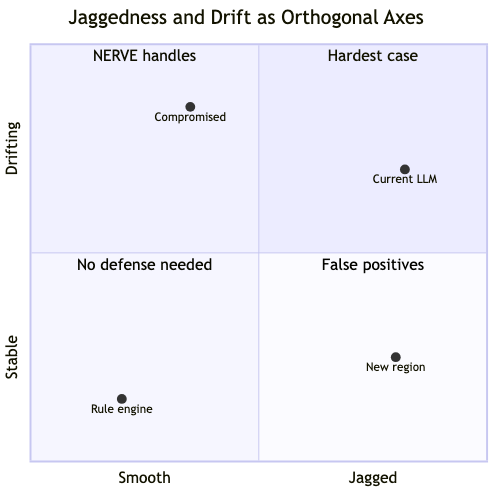
Section titled “2.3 The Interaction”Jaggedness and drift interact but are not the same phenomenon.
- Jagged but stable. The agent has always been competent in some regions and incompetent in others, and nothing has changed. Behavior appears variable when measured across regions, but the capability surface itself is unchanged.
- Smooth but drifting. The agent’s capability is relatively uniform across tasks, and the behavioral shift over time is the signal. Single-fingerprint drift detection (as in current NERVE) correctly flags this case.
- Jagged and drifting. The agent’s capability is uneven, and the jagged pattern itself has shifted. This is the hardest case. It requires a surface-level representation to separate signal from noise.
The failure mode a protocol-layer defense must avoid is treating
jaggedness as drift. If a MicroglialObserver flags a task failure as
drift when the task was always in a capability valley that was never
covered at baseline, the signal is a false positive. False positives
erode trust in the integrity layer and lead operators to disable the
observer or widen the threshold until real drift signals are also
missed.
2.4 A Clinical Analogy
Section titled “2.4 A Clinical Analogy”An informal analogy clarifies the distinction. Consider a clinical team monitoring an elder for cognitive decline. The team establishes a baseline at enrollment: specific cognitive tasks (naming animals, repeating a sequence, identifying the date) at which the elder scores a recorded baseline. Over subsequent visits, the team measures the same tasks and looks for change. A decline in task performance from baseline is a signal of decline (drift). A long-standing inability in a task the elder was never able to perform (for example, a non-native-language vocabulary task) is not decline; it is a known region of non-competence. Conflating the two would produce false alarms on every visit and the team would stop trusting the measurement. This is exactly the failure mode a drift-detection system inherits if it does not account for jaggedness.
Pratyahara [7] is the protocol-layer analog of the clinical monitoring system. It is not designed to diagnose global incompetence (the equivalent of pre-existing cognitive conditions); it is designed to detect change from baseline. For Pratyahara to perform this function reliably, its baseline must be a surface, not an aggregate.
2.5 From the Clinical Analogy to the Protocol Primitive
Section titled “2.5 From the Clinical Analogy to the Protocol Primitive”So once we had the change-detector framing from Section 2.4 next to the jagged-frontier research from Section 1, the question became practical. Pratyahara cannot tell us whether an agent was always weak at something; it only notices when behavior has moved. But human cognition is also uneven in healthy people, and clinicians have been detecting decline in that setting for decades. We asked how they do it.
They do not use one test. They use a battery. Multiple subtests, each sampling a different cognitive region, administered at intake to establish where the person starts, and re-administered on later visits to see what has moved. A drop on a subtest that was already low is not news. A drop on a subtest that was high is. The shape of the baseline is preserved, and change is measured per region, not against an average person.
This is exactly the shape an agent drift detector needs, and for the same reason. A single fingerprint averages across the agent’s uneven terrain and loses the information we need to spot real change. A battery preserves the terrain. A region that was always a valley stays a valley, and we do not flag it as drift. A region that was a peak and now shows a valley is the signal.
The pattern is already in three fields we know.
Clinical neuropsychology. The MMSE, MoCA, and WAIS are batteries of subtests sampling different cognitive regions, administered at intake and re-run at follow-up to detect decline per region. A related instrument, the MacCAT-T, is used for decision-capacity rather than decline and appears in the companion Sauvidya protocol [13] for that purpose.
Machine learning evaluation. BIG-Bench, MMLU, and the Holistic Evaluation of Language Models (HELM) are fixed batteries sampling model capability across regions, with per-domain sub-scores already recorded. What ML has not done yet is turn those batteries into runtime-queryable deployment artifacts that peer agents can consult.
Software regression testing. A regression test suite is a fixed battery run on each change, flagged against a known baseline. The difference from our case is that regression is deterministic and binary; a capability surface is probabilistic.
We are not inventing the method. We are translating it into protocol-layer vocabulary, such that a peer agent can query an agent’s capability surface the way a clinician reads a neuropsychological report, a model developer reads a benchmark, or a CI system reads a regression result. Section 3 formalizes the primitive; Section 4 makes it enforceable.
3. The Capability Surface Primitive
Section titled “3. The Capability Surface Primitive”We define a protocol-layer primitive CapabilitySurface that represents
an agent’s observed competence across discrete capability regions.
CapabilitySurface is designed to be published on an A2A AgentCard
extension and queried by other agents or principals before engagement.
3.1 CapabilityRegion
Section titled “3.1 CapabilityRegion”A CapabilityRegion is a named, documented region of the task space in
which an agent claims competence. Regions are coarse-grained: a small
number of regions (typically 5-30) covering the agent’s declared
responsibilities. Fine-grained task-level classification is out of
scope; regions are at the level of “multi-step arithmetic,” “clinical
summary generation,” “code refactoring within a single file,”
“scheduling across time zones.”
Formally, a CapabilityRegion is a tuple:
CR = (region_id, description, probe_task_ids, acceptance_criteria)where region_id is a URI (typically namespaced under the agent’s
extension URI), description is human-readable prose, probe_task_ids
is the list of probe tasks that sample this region, and
acceptance_criteria defines what observed performance on the probe
tasks counts as “covered” (e.g., success rate ≥ 0.85 over the last
N probe runs).
3.2 ProbeBatteryResult
Section titled “3.2 ProbeBatteryResult”A ProbeBatteryResult records the outcome of running the probe tasks
for a single region at a specific time. It is the atomic observation
from which a capability surface is built.
Formally:
PBR = (id, region_id, agent_id, run_at, task_results, aggregate_score, covered, confidence)where task_results is a list of per-task outcomes (pass, fail, or
score), aggregate_score is the summary metric, covered is a boolean
derived from acceptance_criteria, and confidence reflects the
sample size and variance in the battery.
Invariant PBR-1 (Immutability). A ProbeBatteryResult is
append-only. Agents MUST NOT modify past results; a re-run produces a
new ProbeBatteryResult with a new id and run_at.
Invariant PBR-2 (Attribution). The agent_id on a
ProbeBatteryResult MUST identify the agent whose capability was
measured. A ProbeBatteryResult produced by a different agent is a
claim, not an observation, and MUST be carried separately.
Note on aggregate scores. An aggregate score is a summary, and
like the published benchmark scores criticized in Section 1.1, can
hide tail failures. A battery
result that reports only the mean can mask a systematic failure on
a specific subclass within the region. Implementations SHOULD
therefore preserve per-task-class breakdowns inside task_results
and expose them to peers that request them; the aggregate is a
convenience for summary queries, not a substitute for the
underlying distribution.
3.3 CapabilitySurface
Section titled “3.3 CapabilitySurface”A CapabilitySurface is the agent’s published capability map, composed
of the most recent ProbeBatteryResult for each declared region plus
metadata about refresh cadence.
Formally:
CS = (agent_id, regions, covered_regions, uncovered_policy, refresh_cadence_hours, last_full_refresh_at)where regions is a dictionary of region_id -> ProbeBatteryResult,
covered_regions is a derived set of region ids where covered = true,
uncovered_policy ∈ {observe, defer, reject} declares how the agent
handles tasks that fall outside its covered regions, and
refresh_cadence_hours is the declared maximum age of the probe
results.
Invariant CS-1 (Declared Policy). The uncovered_policy MUST be
declared at agent registration and MUST NOT change silently. A policy
change is itself an event that observers record.
Invariant CS-2 (Freshness). A ProbeBatteryResult older than
refresh_cadence_hours is stale and MUST NOT contribute to the
covered_regions set. Staleness is structurally equivalent to
uncovered: the agent is treated as not having a baseline in the region
until a fresh probe result is recorded.
Invariant CS-3 (Uncovered Conservatism). For any task that an
observer cannot confidently classify into a covered region, the task
MUST be treated as uncovered. Classification uncertainty is itself a
coverage failure, handled by the uncovered_policy.
3.4 Operations
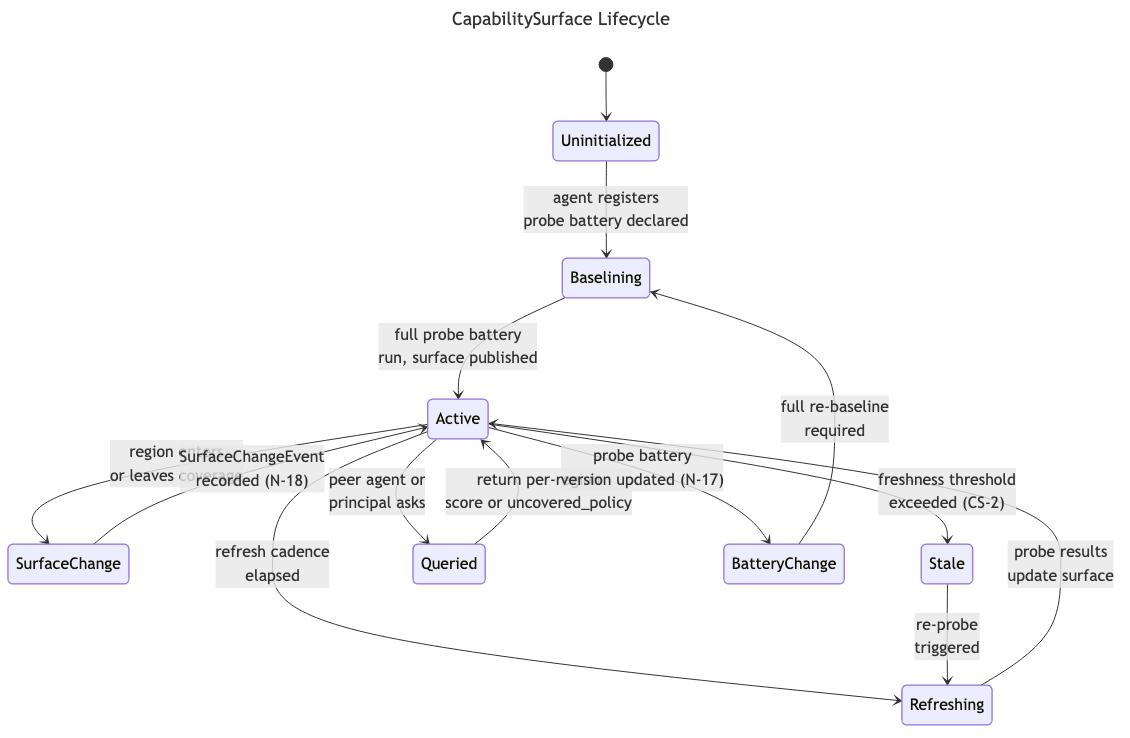
Section titled “3.4 Operations”Three operations define the lifecycle of a CapabilitySurface.
- Baseline. The agent (or a trusted third party acting on its
behalf) runs the full probe battery for each declared region once at
initialization, producing the first
ProbeBatteryResultset and the derivedcovered_regions. - Refresh. On the declared cadence, the probe battery is re-run
(either in full or partially). New
ProbeBatteryResultentries supersede old ones. A region may move out ofcovered_regionsif a refresh fails the acceptance criteria. Implementations SHOULD apply a consecutive-failure rule or a smoothed scoring function such as an exponentially weighted moving average over the last N probe runs before emitting a coverage transition, so that single-run statistical noise does not drive spurious churn in the covered set. - Query. A peer agent or principal queries the
CapabilitySurfaceby submitting a task and receiving back (a) the classified region if in coverage, (b) the aggregate score and confidence for that region, and (c) theuncovered_policyaction if the task is not in coverage.
The query operation is the protocol-level answer to Gans’s information economics problem [3]. A rational principal can now observe local reliability (per-region) rather than relying on aggregate benchmarks that hide the shape of capability.
4. Integration with NERVE
Section titled “4. Integration with NERVE”Pratyahara NERVE [7] provides behavioral drift detection through
MicroglialObserver and AgentNeuron fingerprinting. The current
specification records a single behavioral_fingerprint for each agent,
against which subsequent behavior is compared. This conflates jaggedness
with drift in exactly the failure mode described in Section 2.3.
We propose three invariants that extend NERVE with capability-conditional drift detection. These invariants do not replace existing NERVE invariants; they refine the domain over which drift detection is valid. Existing integrity guarantees remain intact for covered regions.
4.1 N-16: Coverage-Conditional Drift
Section titled “4.1 N-16: Coverage-Conditional Drift”A MicroglialObserver MUST NOT raise a drift flag for a task that
does not map to a region in the agent’s covered_regions set, and
MUST NOT raise a flag against a region whose latest probe is older
than RefreshCadence. Tasks outside coverage are classified as
jaggedness (unknown competence) rather than drift (change from known
baseline). The observer’s response to an uncovered or stale task is
governed by the agent’s declared uncovered_policy, not by drift
threshold logic.
Form of the invariant. N-16 is an action-level safety property
on the RaiseDrift operation, not a state-level claim about the
historical set of drift flags. Concretely, the TLA+ specification
encodes it as the enabling guard of RaiseDrift(a, r):
RaiseDrift(a, r) == /\ r \in covered[a] \* (i) /\ (clockTick - lastRefreshAt[<<a, r>>]) <= RefreshCadence \* (ii) /\ driftFlags' = driftFlags \cup {<<a, r, clockTick>>} /\ ...A state-invariant formulation (”∀ flag ∈ driftFlags: the flag’s region
is currently covered and fresh”) would be unsatisfiable: driftFlags is
append-only while covered_regions and clockTick are mutable, so after
a flag is legitimately raised, a subsequent probe can shrink coverage or
time can advance past the freshness window, and a historically-correct
flag then falsifies the state-only form even though no rule was violated.
N-16 is therefore stated as an action-level property, which is what the
design requires.
Rationale. Drift is meaningful only with respect to a baseline. An agent that has never been measured on task X cannot be said to have “drifted” on task X; its behavior on X is outside the observed domain. Flagging such behavior as drift produces false positives that erode the integrity layer’s credibility.
4.2 N-17: Probe Battery Maintenance
Section titled “4.2 N-17: Probe Battery Maintenance”Each AgentNeuron MUST declare a probe_battery field that enumerates
the probe tasks used to establish and refresh its CapabilitySurface.
The probe battery MUST be version-controlled and content-addressed (a
SHA-256 hash over the canonical serialization). A change in the probe
battery is a distinct event and MUST trigger a full baseline re-run,
not a silent surface update.
Rationale. The capability surface has meaning only with respect to its probe battery. Changing the battery changes the measurement. An observer cannot compare a pre-change probe result to a post-change one; they are measurements of different things. Versioning the battery makes surface changes auditable and prevents a compromised agent from silently redefining its own measurement. The canonical serialization used for the hash SHOULD follow the JSON Canonicalization Scheme (RFC 8785 [12]) to ensure that independent implementations computing the digest of the same battery produce the same value.
4.3 N-18: Capability Surface Integrity
Section titled “4.3 N-18: Capability Surface Integrity”A change in the covered_regions set, whether from probe failures
(region moves out), new probes (region moves in), or policy changes
(uncovered policy adjustment), MUST be recorded as a distinct event
type SurfaceChangeEvent, separate from fingerprint drift within a
region. The MicroglialObserver MUST treat unexpected surface changes
as integrity signals in their own right, with escalation rules
separate from drift.
Rationale. An agent whose capability surface suddenly expands or contracts is exhibiting a different kind of integrity signal than one whose behavior on a covered task has drifted. A compromised agent may claim expanded coverage it cannot actually deliver; a drifting agent may lose coverage in regions where it used to be reliable. Separating these events prevents one from being masked by the other.
4.4 Timescale and Cooperation
Section titled “4.4 Timescale and Cooperation”The two mechanisms run on fundamentally different timescales, and
this distinction is important for implementers. A probe battery is
scheduled, not continuous: it runs once at intake to establish
baseline and re-runs on a declared cadence such as hours, days, or
weeks, depending on how critical the agent is. Executing a probe
battery is relatively expensive because it means running a
standardized set of tasks and recording per-task results, and this
is not something an operator wants to do on every incoming request.
The MicroglialObserver, by contrast, runs continuously in real
time on every action the agent takes, comparing the observed
behavior against the fingerprint already stored in the
CapabilitySurface for the classified region. The observer does
not execute probes; it only consults the per-region fingerprint
that the most recent probe run left behind.
The two mechanisms cooperate by working on complementary loops. The
probe-battery loop maintains the fingerprints and the covered set
over time, in response to scheduled refresh or operator-triggered
re-probing. The observer loop reads those fingerprints and enforces
N-16 on every action: if the classified region is covered and
fresh, a drift check runs; if it is uncovered or stale, the
observer defers to the agent’s declared uncovered_policy
instead. This decoupling is what makes the combined system
practical: the slow, expensive probe loop does not have to run on
the request critical path, and the fast, cheap observer loop does
not have to re-measure what the probe battery has already measured.
For deployments that implement NERVE core without the Yathartha
extension, no probe battery is required. The MicroglialObserver
falls back to single-fingerprint drift detection and accepts the
false-positive risk on jagged valleys described in Section 2.3.
Yathartha is an opt-in refinement, not a prerequisite.
A reference implementation is available in the companion Pratyahara
repository at https://github.com/ravikiran438/pratyahara-nerve.
The repository follows the same split used by the Anumati extensions
[7]: specification artifacts live under extensions/yathartha/
(README.md, STATUS.md, the TLA+ specification Yathartha.tla,
and the TLC configuration Yathartha.cfg), while the Python
implementation lives under src/nerve/extensions/yathartha/
(Pydantic types for the three primitives and runtime validators for
N-16 through N-18). A pytest suite of twenty-one invariant scenarios
is under tests/extensions/test_yathartha.py.
4.5 Combined Effect
Section titled “4.5 Combined Effect”With N-16, N-17, and N-18 in place, NERVE’s behavioral monitoring
becomes capability-conditional. Drift signals are narrower and more
trustworthy, because they are gated on a baseline that actually
exists. Jaggedness is handled by the uncovered_policy route:
observe, defer, or reject. Surface changes are a new class of
event with their own handling.
The hardest case identified in Section 2.3, an agent that is both
jagged and drifting, is resolved by the interaction of N-17 and
N-18. When a refresh probes a previously covered region and the
new aggregate score falls below the region’s acceptance threshold,
the region is moved out of covered_regions and a
SurfaceChangeEvent of kind left is recorded. Subsequent
observations of degraded behavior in that region are then routed
through uncovered_policy, not through drift detection. The
surface itself is what separates signal from noise in the
jagged-and-drifting case: drift is measurable only while the
region is covered, and the moment the region falls below threshold
the shape of the surface has changed, which is a distinct event
class with its own downstream handling.
The combined effect is a more precise defense surface that does not confuse pre-existing incompetence with post-deployment compromise.
5. Related Work
Section titled “5. Related Work”5.1 Jagged Intelligence Literature
Section titled “5.1 Jagged Intelligence Literature”Dell’Acqua et al. introduced the jagged frontier framing in their 2023 HBS field experiment with BCG consultants [2], which provides the quantitative anchor: 40 percent higher quality on tasks inside the frontier, and 19 percentage points less likely to be correct on tasks outside it. Mollick and Euchner’s 2024 interview in Research-Technology Management popularized the framing and prescribes organizational responses [1]. Gans’s information-economics treatment provides the theoretical framework for rational adoption under jagged capability [3]. Chaudhri’s Undark opinion piece argues for structured knowledge bases as a mitigation [6]. None of these works addresses the protocol layer. None proposes a measurement primitive that agents can publish and principals can query.
5.2 Capability Evaluation Benchmarks
Section titled “5.2 Capability Evaluation Benchmarks”Benchmarks such as MMLU, BIG-Bench, and HumanEval aggregate
model performance across diverse tasks. They are used for inter-model
comparison, not for per-agent capability surface publication. A model’s
aggregate MMLU score tells an operator little about how reliable that
model is on the operator’s specific task mix. Published benchmark
scores do not serve the function that a CapabilitySurface would
serve: a queryable, agent-specific, refresh-cadenced map of where the
agent is actually reliable.
5.3 Agent Drift Detection
Section titled “5.3 Agent Drift Detection”Rath et al.’s Agent Stability Index (ASI) proposes quantitative drift metrics across twelve behavioral dimensions [10]. Becker et al.’s DRIFTJudge identifies problem drift in multi-agent debate sessions [11]. Both treat drift as an absolute property of agent behavior. Both would benefit from conditioning on capability surface; both would flag false positives on tasks the agent was never competent at.
The Yathartha framework is complementary to these methods. An ASI score or a DRIFTJudge signal can be computed within a covered region and used as the fingerprint comparison metric. The surface-level conditioning is orthogonal: it determines whether the metric’s output is meaningful, not what the metric measures.
5.4 Formal Capability Specification
Section titled “5.4 Formal Capability Specification”Prior work in program verification and API contracts specifies what a system is expected to do. Capability surface differs in two respects. First, it specifies what the system actually demonstrates (via the probe battery), not what it is declared to do. Second, it is refresh-cadenced and can change over time, whereas API contracts are static. The closest analog is runtime contract verification, but runtime verification assumes a fixed specification; capability surface assumes an evolving one.
6. Limitations and Future Work
Section titled “6. Limitations and Future Work”6.1 Probe Battery Design
Section titled “6.1 Probe Battery Design”The probe battery for a given region must be representative of the region’s task space. Poor battery design produces poor coverage assessment: an agent can pass a battery of easy probes and fail real tasks in the same nominal region. Battery design is domain-specific and is currently an unsolved problem in the general case. For specific domains (coding, summarization, arithmetic, scheduling), existing benchmark suites provide candidate probes. For open-ended domains, no principled design method exists.
6.2 Capability Region Classification
Section titled “6.2 Capability Region Classification”The query operation depends on classifying an incoming task into a
region. For some domains the classification is trivial (the agent
exposes one skill per region). For others it is itself a probabilistic
inference problem. A misclassified task is either treated as covered
when it should not be, or treated as uncovered when it could have
been handled. Both failure modes have costs. The paper’s
CS-3 Uncovered Conservatism invariant favors false uncovered over
false covered, which is safer but more conservative.
6.3 Empirical Validation
Section titled “6.3 Empirical Validation”This paper specifies the primitive and the invariants; it does not provide empirical measurement. A natural next step is a simulation study that injects drift at controlled rates into a jagged agent and measures whether surface-conditioned drift detection (Yathartha plus NERVE) produces fewer false positives than aggregate drift detection (NERVE alone) while maintaining equivalent true-positive rates.
6.4 Adversarial Probe Batteries
Section titled “6.4 Adversarial Probe Batteries”A compromised agent that controls its own probe battery can publish a battery easy enough to pass regardless of underlying behavior. The N-17 invariant requires probe battery content-addressing to make such changes auditable, but does not prevent an adversary from initially choosing a weak battery. Trusted third-party probe batteries, curated by the agent network or a neutral registry, are a natural complement. The specification of such registries is out of scope for this paper.
6.5 Relationship to Training-Time Methods
Section titled “6.5 Relationship to Training-Time Methods”Yathartha is a deployment-time specification. It does not address whether jaggedness can be reduced at training time through better data curation or architectural choice. Gans’s information-economics framework argues that scaling laws improve average quality without eliminating jaggedness [3]; empirical confirmation across model families is ongoing. Even if training-time improvements reduce the magnitude of jaggedness, the protocol-layer treatment remains necessary, because deployed agents can still drift within their jagged profile.
6.6 Benchmark Contamination and Goodhart’s Law
Section titled “6.6 Benchmark Contamination and Goodhart’s Law”A protocol primitive that makes probe-battery results into queryable deployment artifacts creates two failure modes that do not apply to benchmarks used once by a model developer. We describe them here because any honest deployment of the primitive must address them.
The first is training-data contamination. Any publicly known probe
battery is likely present in the training corpus of a modern
generative model, which inflates measured competence on that battery
relative to held-out tasks in the same region. A CapabilitySurface
built from a public battery is therefore an overestimate of the
agent’s actual capability, and peer agents that query the surface will
trust the agent in regions where it has only learned to pass the
probe.
The second is optimization pressure. Once a surface becomes a gate that peers consult before engagement, every agent has a direct incentive to score well on the probes, independently of whether the underlying capability has improved. This is Goodhart’s Law applied at the protocol layer: the measure becomes the target, and the target detaches from the construct the measure was meant to represent. An honest agent does not need to intend this for it to occur; routine fine-tuning that happens to include probe tasks in a training loop produces the same result.
Both failure modes mean that probe-battery design cannot rely on public benchmarks alone. Plausible mitigations include private batteries curated by a trusted registry, rotation schedules that replace the active battery periodically, and out-of-distribution probe tasks that do not appear in any public corpus. The specification of such a registry and its governance is out of scope for this paper, but it is a necessary companion to any deployment of the primitive in an adversarial setting.
6.7 Third-Party Probers and the Attestation Layer
Section titled “6.7 Third-Party Probers and the Attestation Layer”The practicality of every safeguard in this paper reduces to a single
operational question: who runs the probe battery, and how does a peer
agent verify that a published ProbeBatteryResult reflects what
actually happened? The specification as written assumes the agent
runs its own probes and publishes its own results. Content-addressed
batteries (N-17) prevent silent battery swaps, but do not prevent
cherry-picked runs, selective reporting, or outright fabrication. The
framework as specified is therefore a contract between honest agents.
That is useful in trusted single-organization deployments, but it is
not adversarially robust in open multi-organization networks.
Every real-world analog of the probe-battery pattern addresses this through third-party execution. Clinicians administer neuropsychological batteries; patients do not self-score. Continuous integration runs regression tests on independent infrastructure; developers do not publish test results from their own laptops. Benchmark leaderboards are computed by shared evaluation platforms; model developers do not run the scoring code and submit their own numbers. The corresponding piece of infrastructure for agent networks does not yet exist. Specifying it is the natural companion work to this paper, and it is composed of three pieces.
Probe-execution runtime. The execution of the probe battery itself can be handled by existing open-source evaluation frameworks. Four candidates are production-grade and maintained: Inspect [14] from the UK AI Safety Institute, which has sandboxed task execution and structured eval protocols; the LM Evaluation Harness [15] from EleutherAI, which has the widest coverage of standardized benchmarks; Promptfoo [16], designed for continuous-integration-style LLM testing; and HELM [17] from Stanford CRFM, designed for multi-dimensional holistic evaluation. Of these, Inspect is the closest structural match because it assumes sandboxed execution under the control of a party other than the model being evaluated, which is precisely the assumption a third-party prober must enforce.
Prober service architecture. Running the framework is the easy
part. A third-party prober service is an operational layer on top: the
agent registers its battery specification, the prober runs the battery
independently against the agent, and the result is returned as a
signed ProbeBatteryResult. The pattern is analogous to
continuous-integration services (GitHub Actions, CircleCI, Buildkite)
that run tests on independent infrastructure rather than the
developer’s machine. The specification of this service, including API
shape, authentication, and cost accounting, is out of scope for the
present paper.
Attestation format and trust anchor. Results returned by a prober
service MUST be signed with the prober’s private key, and the prober’s
public key MUST be resolvable by peers who want to verify the result.
A peer querying a CapabilitySurface then needs a way to decide
whether the signing prober is itself trustworthy, which is the same
problem TLS certificates solve through certificate authorities.
Possible structures include a federated registry of accredited probers
modeled on TLS CAs, a decentralized reputation system based on
cryptographic proofs of past honest behavior, or institution-anchored
trust through AI Safety Institutes, universities, or regulatory
bodies. The specification of the trust anchor is the hardest of the
three pieces and is also out of scope here.
Until these three components are specified and deployed, Yathartha’s value in adversarial settings is bounded by the trust relationships that already exist inside a single deploying organization. In single-organization or federated-partner deployments, this is fine; the framework formalizes what would otherwise be an informal contract. In open multi-organization agent networks, the attestation layer is not optional.
7. Conclusion
Section titled “7. Conclusion”Jagged intelligence is a structural property of current generative AI systems, and the literature describing it has established the phenomenon, measured its workplace impact, and proposed organizational responses. The protocol layer has been untreated. Agent integrity specifications that monitor behavioral drift without accounting for jaggedness conflate two different phenomena and produce false positives on tasks the agent was never competent at. The cost of the conflation falls on the principal, who either sees the integrity layer’s alerts lose credibility or sees real drift signals hidden among jaggedness noise.
Yathartha proposes a protocol-layer treatment. A CapabilitySurface
primitive records what the agent is actually competent at, published
on a refresh cadence and queryable by peers. Three derived invariants
(N-16 through N-18) extend the Pratyahara NERVE specification to
condition drift detection on the covered surface. The result is a
cleaner separation between what the agent has always failed at (handled
by the uncovered policy route) and what the agent has started to fail
at (handled by the drift route).
The primitive is agent-agnostic. It does not depend on a specific model architecture, does not require retraining, and does not propose behavioral change at training time. It is a measurement and publication contract that any agent protocol can adopt alongside A2A and MCP. It treats jaggedness as what it is: a property of the agent’s capability surface, to be mapped honestly rather than averaged away.
One practical caveat deserves explicit mention. The primitive’s value in adversarial settings is contingent on a third-party prober and attestation layer that does not yet exist in the agent-protocol ecosystem, and that is out of scope for this paper (see Section 6.7). Until that layer is specified and deployed, Yathartha is a contract between honest agents: useful, but not adversarially robust. The specification of the prober service and the trust anchor that backs it is the natural companion work.
References
Section titled “References”[1] Mollick, E. and Euchner, J. The Jagged Frontier: Navigating AI’s Uneven Capabilities. Research-Technology Management, 2024. See also “The Shape of AI Jaggedness, Bottlenecks, and the Future,” One Useful Thing, 2026.
[2] Dell’Acqua, F., McFowland, E., Mollick, E., Lifshitz-Assaf, H., Kellogg, K., Rajendran, S., Krayer, L., Candelon, F., and Lakhani, K. R. Navigating the Jagged Technological Frontier: Field Experimental Evidence of the Effects of AI on Knowledge Worker Productivity and Quality. Harvard Business School Working Paper 24-013, September 2023.
[3] Gans, J. A Model of Artificial Jagged Intelligence. arXiv preprint arXiv:2601.07573, 2026.
[4] Liu, Y. et al. Prompt Injection attack against LLM-integrated Applications. arXiv preprint arXiv:2306.05499, 2025. https://arxiv.org/abs/2306.05499
[5] Greshake, K. et al. Not What You’ve Signed Up For: Compromising Real-World LLM-Integrated Applications with Indirect Prompt Injection. AISec 2023, pp. 79-90. ACM.
[6] Chaudhri, V. Opinion: The Jagged Intelligence Problem and the Case for Knowledge Graphs. Undark, February 19, 2026.
[7] Kadaboina, R. K. Pratyahara: A Neural Tissue Defense Model for Detecting Compromised Agents in Multi-Agent Networks. Zenodo, 2026. DOI: 10.5281/zenodo.19628588.
[8] Linux Foundation AI & Data. Agent2Agent (A2A) Protocol Specification, 2026. https://a2aproject.org
[9] Anthropic. Model Context Protocol Specification, November 2025. https://modelcontextprotocol.io
[10] Rath, A. Agent Drift: Quantifying Behavioral Degradation in Multi-Agent LLM Systems Over Extended Interactions. arXiv preprint arXiv:2601.04170, 2026. https://arxiv.org/abs/2601.04170
[11] Becker, M. et al. Problem Drift in Multi-Agent Debate. Findings of EACL 2026.
[12] Rundgren, A., Jordan, B., and Erdtman, S. JSON Canonicalization Scheme (JCS). RFC 8785, June 2020. https://datatracker.ietf.org/doc/rfc8785/
[13] Kadaboina, R. K. Sauvidya: An Accessibility Protocol for Agent-to-Principal Interaction in Autonomous Agent Networks. Zenodo, 2026. DOI: 10.5281/zenodo.19633138.
[14] UK AI Safety Institute. Inspect: Open-Source Framework for AI Safety Evaluations, 2024. https://inspect.aisi.org.uk/
[15] Gao, L., Tow, J., Biderman, S., Black, S., DiPofi, A., Foster, C., Golding, L., Hsu, J., McDonell, K., Muennighoff, N., and others. A Framework for Few-Shot Language Model Evaluation (LM Evaluation Harness). EleutherAI, 2021-2024. https://github.com/EleutherAI/lm-evaluation-harness
[16] Promptfoo, Inc. Promptfoo: Test and Evaluate LLM Output Quality. 2023-2026. https://www.promptfoo.dev/
[17] Liang, P., Bommasani, R., Lee, T., Tsipras, D., Soylu, D., Yasunaga, M., Zhang, Y., Narayanan, D., Wu, Y., Kumar, A., and others. Holistic Evaluation of Language Models (HELM). Stanford CRFM, 2022. https://crfm.stanford.edu/helm/