Pramana: A Protocol-Layer Treatment of Claim Verification in Autonomous Agent Networks
Ravi Kiran Kadaboina
Independent Researcher
M.S., Computer Engineering, University of New Mexico, 2011
Abstract
Section titled “Abstract”Autonomous agents deployed in regulated domains must produce
a verification artifact per consequential output. The
artifact is a record an auditor can re-execute offline,
capturing what was claimed, against what source, by whom,
when, and how. Production verification today splits into two
unstandardized halves. Probabilistic verdict patterns
(self-consistency voting, confidence-scored outputs,
reviewer LLM (large language model) ensembles) produce
judgments about model outputs, not artifacts.
Artifact-producing patterns (retrieval-augmented generation
with citations, tool-augmented traces, generator-verifier
loops, and recent multi-agent research systems such as
Google’s AI co-scientist [42]) produce vendor-specific
records that an external auditor cannot reconstruct without
bespoke integration.
Pramana defines the missing wire format: a typed claim
attestation with a deterministic verify() contract,
layered as an A2A and MCP extension.
Pramana wraps every consequential agent output in a typed
ClaimAttestation with one of four variants (measurement,
inference, analogy, citation), each paired with a verify()
operation against the recorded source. For MeasurementClaim
and CitationClaim, verify() is a deterministic function
of (claim, source) and no probabilistic judge participates
in the verification step. For InferenceClaim and
AnalogyClaim the determinism is conditional on the oracle:
deterministic when the oracle is a theorem prover, structural
matcher, or fixed-metric similarity function;
audit-replayable when the oracle is an LLM. The four-way
typology is derived from classical Indian epistemology
(pramana, “the means of valid knowledge”) and partitions
agent claims by their ground.
The Pramana lifecycle is specified in TLA+ (Temporal Logic of Actions) and exhaustively verified under TLC (TLA+‘s model checker) across three symmetry-reduced models, totaling 38,563 distinct reachable states with zero invariant violations. The Python reference implementation passes 84 unit and property-based tests. A wire-extension manifest publishes the format for A2A (Agent2Agent) [1] and MCP (Model Context Protocol) [2] agents, with three deployment-grade invariants (reachability, service-level-agreement (SLA) bound, and offline re-verifiability) layered on top.
We report an exploratory pilot (n=100 problems, approximately 1.3M tokens across 2,275 reviewer calls) that probes the LLM-as-judge alternative in code generation. The strongest observation is a roughly 40-percentage-point raw FPR (false-positive rate) delta between corpora under the same ensemble, consistent with reference-solution quality contributing significantly; differential prompt-overfit across corpora during the selection phase is an alternative driver that the single-rater design cannot rule out. The pilot does not validate Pramana on its own; the structural argument in Sections 1 through 4 and the formal verification in Section 6 do that.
1. Introduction
Section titled “1. Introduction”A high-stakes agent deployment needs more than an output that is probably correct. It needs a record of what was claimed, against what source, by whom, when, in a form an external auditor can re-execute offline. Production verification today splits into two halves. Probabilistic verdict patterns (self-consistency voting, confidence scores, reviewer LLM ensembles) produce judgments about model outputs, not artifacts; aggregating judgments does not change their category. Artifact-producing patterns (retrieval-augmented generation with citations, tool-augmented traces, generator-verifier loops as in FunSearch [30] and AlphaEvolve [31], and recent multi-agent research systems such as Google’s AI co-scientist [42]) produce vendor-specific records but no shared wire format. An auditor inspecting a multi-vendor agent network cannot reconstruct verification across patterns without bespoke per-vendor integration.
The verification artifact a regulator wants has a structurally
different shape from a verdict. An artifact records the claim,
the source it was checked against, the procedure used to check
it, the verifier identity, the timestamp, and the outcome.
Pramana defines the typed wire format that standardizes
this artifact. It is published as an A2A and MCP extension manifest
at https://ravikiran438.github.io/pramana-attestation/v1 via the capabilities.extensions
mechanism those host protocols define, alongside sibling
extensions (Anumati, Yathartha, Phala, Sauvidya, Pratyahara)
addressing other wire-level concerns.
The rest of this paper is organized as follows. Section 1.1 describes what the protocol layer is currently missing. Section 1.2 surveys the regulatory pressure motivating this work. Section 1.3 lists the contributions. Section 2 defines the Pramana primitive. Section 3 describes composition with the existing stack. Section 4 maps the regulatory landscape onto specific primitives. Section 5 reports the supplementary empirical pilot. Section 6 reports the formal correctness properties. Section 7 surveys related work. Section 8 lists limitations and future work.
1.1 What the protocol layer is missing
Section titled “1.1 What the protocol layer is missing”A2A [1] and MCP [2] standardize agent communication at the syntactic level (messages, tasks, agent cards, tool calls, tool results), but neither defines a typed vocabulary for the epistemic ground of an agent output. A tool result in MCP is a content blob; an A2A agent message is a text payload. Neither carries a typed attestation of source URI, measurement record, or inference chain. Pramana adds the missing vocabulary, with each variant naming the epistemic ground that warrants the claim plus the metadata required to verify it independently.
ClaimAttestation is parameterized by claim type. For
MeasurementClaim and CitationClaim the verification step
is structurally deterministic: verify() is a function of
(claim, source) and no probabilistic judge participates.
For InferenceClaim and AnalogyClaim the verification
step’s determinism is conditional on the oracle plugged into
the verify() slot, deterministic when the oracle is a
theorem prover, structural matcher, or fixed-metric
similarity function, and audit-replayable rather than
bit-deterministic when the oracle is an LLM. Section 2.5
specifies the partition.
1.2 Regulatory pressure
Section titled “1.2 Regulatory pressure”Regulators across jurisdictions converge on artifact-requiring compliance bars. CFPB Circular 2023-03, Federal Reserve SR 11-7, NYDFS Insurance Circular Letter No. 7, HHS OCR’s Section 1557 Final Rule, the EU AI Act, NYC Local Law 144, and the Colorado and California state AI laws all require per-decision documentary records that an external auditor can re-execute. The regulatory frameworks specify the audit substrate (a re-verifiable record per consequential output) rather than a particular verification pattern. Section 4 maps each requirement to the Pramana primitive that produces the substrate.
1.3 Contributions
Section titled “1.3 Contributions”- A typed wire-format primitive: a
ClaimAttestationwith four variants (measurement, inference, analogy, citation) derived from the classical pramana taxonomy of valid knowledge, each paired with averify()operation against the recorded source. The four variants partition agent claims by epistemic ground; verification determinism by claim type is specified in Section 2.5. - A TLA+ specification of the lifecycle, exhaustively verified under TLC across three symmetry-reduced models (38,563 distinct reachable states, zero invariant violations), plus a Python reference implementation that passes 84 unit and property-based tests.
- An A2A and MCP wire-extension manifest
(
claim-attestation/v1) with three deployment-grade invariants: reachability, SLA-bound, and offline re-verifiability. - An exploratory pilot (n=100, approximately 1.3M tokens) that probes the LLM-as-judge alternative in code generation and characterizes the measurement regress in reviewer-ensemble evaluation.
2. The Pramana Primitive
Section titled “2. The Pramana Primitive”A ClaimAttestation is a structured assertion an agent makes
about something it has observed, inferred, compared, or cited.
Each attestation declares the epistemic ground that warrants
the claim plus enough metadata for any party holding the
source to verify the claim independently.
2.1 The four claim types
Section titled “2.1 The four claim types”The taxonomy follows the four ways a claim can be grounded in observable reality.
| Type | Ground | Verification operation |
|---|---|---|
MeasurementClaim | Direct observation or structured record | Source-record fetch and field-match |
InferenceClaim | Logical inference from prior claims | Inference-chain replay |
AnalogyClaim | Similarity to a known reference case | Similarity recompute against reference |
CitationClaim | Attribution to an authoritative source | Source fetch plus faithful-citation check |
Each subtype is a Pydantic v2 model in a discriminated union
over a claim_type field. Pydantic v2 is the data-modeling
library used by both the A2A [1] and MCP [2] reference SDKs,
so a Pramana extension deserializes through the same code
path the host agent already runs for native A2A or MCP
messages. All four share a common envelope
(claim_id, claim_type, claim, attester_id,
attested_at) and contribute type-specific fields: a
MeasurementClaim adds the measured value, unit, method,
source URI, and uncertainty; a CitationClaim adds the source
URI, the verbatim excerpt, and a retrieval timestamp. Full
per-type schemas are in the companion repository.
2.2 Verification semantics
Section titled “2.2 Verification semantics”Each variant’s verify() is a function from (claim, source)
to one of three outcomes: VERIFIED, REJECTED, or
UNVERIFIABLE. The function is deterministic when its
injected dependency is deterministic, such that re-running
with the same inputs produces a bit-identical
VerificationOutcome (up to timestamp and verifier id).
Source fetchers and hash matchers are naturally deterministic;
LLM-backed inference oracles and similarity computers are not,
and Section 2.5 spells out the audit-replayability fallback.
The function is also injectable, with source-fetch,
measurement-fetch, similarity-computation, and inference-
oracle dependencies as constructor arguments. This permits
production-grade caching, SSRF (server-side request forgery)
protection, allow-listing, and
offline auditing without changing the verification logic.
The AnalogyClaim case has one design subtlety worth
surfacing. When similarity_score is recorded, verify()
checks the recomputed score against it within tolerance. When
similarity_score is absent, verify() returns VERIFIED
as long as the similarity computer produced any score, such
that the deterministic check reduces to “the similarity
computation succeeded.” Emitters that want stricter
verification should record a similarity_score explicitly.
Regulated deployments SHOULD require similarity_score for
any AnalogyClaim and SHOULD reject VERIFIED outcomes
lacking it. A VERIFIED outcome without similarity_score is
documentary (the similarity computation succeeded) rather
than substantive (the similarity exceeded a threshold), and
an auditor reviewing such an outcome cannot distinguish a
successful match from a near-miss from a wire-format
inspection alone. The v1 wire format admits both modes
intentionally to support deployments without natural
thresholds; a future revision could introduce a distinct
VERIFIED_UNTHRESHOLDED status to make the distinction
visible at the audit layer.
2.3 Lifecycle invariants
Section titled “2.3 Lifecycle invariants”Five named safety invariants hold across all reachable states.
- P-1 (Single Emission): each claim has at most one emission audit entry.
- P-2 (Verification Determinism): each claim’s verification state is single-valued and reaches a terminal state at most once.
- P-3 (Audit Completeness): every terminal verification, suppression, and disclosure is recorded in the audit trail.
- P-4 (Disclosure Coupling): a claim shown to a principal
has an
emitted, averified, and adisclosedentry in the audit trail. - SuppressionDisclosureDisjoint: no claim is both suppressed and shown to a principal.
Full TLC verification is in Section 6.
2.4 What Pramana verifies and what it does not
Section titled “2.4 What Pramana verifies and what it does not”Pramana is not a hallucination detector, a confidence score, or a replacement for unit tests or human review. It names the verification record that a regulator can demand and the function that produces it. Whether the underlying agent is well-behaved is out of scope. Pramana ensures that if the agent makes a claim, the claim is accompanied by a record any auditor can re-execute.
The artifact-versus-judgment distinction is load-bearing for
the regulated-domain use case. Pramana does not propose to
deterministically verify the underlying judgment in
subjective-ground-truth domains. Whether a diagnosis is
correct, whether a loan applicant is creditworthy, whether an
underwriting decision is fair: these are not deterministic
questions and Pramana does not pretend otherwise. What
Pramana deterministically verifies is the artifact of the
decision: whether the MeasurementClaim’s reported lab value
matches the structured record, whether the InferenceClaim’s
named decision rule was applied as documented, whether the
CitationClaim’s reference to a guideline resolves to the
cited text, whether the AnalogyClaim’s stated similarity to
a prior case recomputes within tolerance. The regulator does
not need to verify the diagnosis; they need to verify the
documentary record of how the diagnosis was constructed.
2.5 Threat model
Section titled “2.5 Threat model”Pramana assumes the source registry is honest within the
deployment’s trust boundary, the cryptographic primitives
backing source_digest and artifact_signature are not
broken, and verifiers run uncompromised code. Under these
assumptions the protocol defends against silent claim
modification (CA-3 makes tampering observable), against
unilateral retraction (P-1 admits at most one emission per
claim), and against unbounded verification latency (CA-2
forces a terminal state within the declared SLA window).
Pramana does not defend against an adversary who fabricates
source content at a URI it controls; that attack is observable
under Pramana but not prevented. In deployments where source
authority matters, Pramana composes with separate
source-attestation primitives (cryptographic signatures,
content-addressed storage, federated registries) via the
source_uri integration point. Concretely, the
source_digest field (Section 3.2) carries a cryptographic
hash of the source bytes at retrieval time; CitationClaim
verifiers MUST reject claims whose freshly-fetched content
does not hash to the recorded digest. This binding is
mandatory for non-unverifiable outcomes (CA-3) and is the
protocol-level integration surface for external source-
attestation infrastructure. The protocol does not specify
particular attestation mechanisms, but constrains their
composition through the digest invariant.
The determinism guarantee holds unconditionally for
MeasurementClaim and CitationClaim, where the injected
dependency is a source fetcher or hash matcher. For
InferenceClaim and AnalogyClaim the guarantee holds when
the oracle is itself deterministic (theorem prover, structural
matcher, fixed-metric similarity function). When the oracle
is a commercial LLM API call, the guarantee fails. Modern
hosted LLMs do not produce bit-identical outputs even at
temperature 0 and a fixed seed, due to floating-point
non-determinism in batched GPU inference, sparse
mixture-of-experts routing variability, and silent backend
updates that are not version-pinned by the provider. For
these deployments Pramana’s contribution narrows to
audit-replayability: the audit trail records the oracle’s
inputs, its output, the model identifier, and the timestamp,
so an auditor can re-execute and observe both the original
verdict and any re-execution verdict that differs. Strict
offline re-verifiability (CA-3) requires constraining oracles
to deterministic procedures.
Audit-replayability is categorically different from raw
logging. The trail captures structured inputs (premises as
a typed list, conclusion as a separate field,
inference_method as a named procedure, source_uri as a
resolvable reference), not the LLM prompt blob. An auditor
querying the trail can recover which decision rule was
claimed to apply, what premises were cited, and which sources
were consulted, independent of whether the oracle’s verdict
on re-execution is bit-identical. Re-execution with the same
oracle and inputs surfaces the direction and magnitude of any
divergence, which is itself queryable evidence. Deployments
that need full verdict reproducibility plug in a deterministic
oracle in the same dependency slot, without changing the wire
format or the audit-trail shape.
Composition with the existing agent-protocol stack, the wire-level extensions to A2A and MCP, and the regulatory landscape this primitive is designed to satisfy are addressed in the next three sections.
3. Composition with the existing stack
Section titled “3. Composition with the existing stack”3.1 Composition with sibling protocols
Section titled “3.1 Composition with sibling protocols”Pramana is one of six wire-level extensions in the
agent-protocol-stack programme, each published as an A2A and
MCP extension via the capabilities.extensions mechanism the
host protocols define. Anumati / ACAP [10] specifies consent
and adherence, where ACAP records the consent for an action
and Pramana records the verification of each claim that fed
the action. Yathartha [11] specifies the capability surface,
such that a capability self-attestation can be a
CitationClaim (weak grounding, with the agent itself as
source) and a third-party probed capability is a
MeasurementClaim (strong grounding). Phala [12] (welfare
feedback), Pratyahara / NERVE [13] (sensory integrity), and
Sauvidya / PACE [14] (accessibility envelope) compose
adjacently. Each protocol follows the same convention and
Pramana takes the role of artifact verification in the stack.
3.2 Wire-level extension to A2A
Section titled “3.2 Wire-level extension to A2A”An agent declares Pramana support by including an entry in
its A2A AgentCard capabilities.extensions array whose
uri matches the Pramana extension URI declared in §1. The
entry deserializes to a
PramanaServiceRef declaring the verify endpoint, audit
endpoint, supported ClaimType values, source-fetcher
schemes, signature algorithm, and SLA window. The receiving
agent uses this declaration to decide what claim types it can
verify against and to route incoming verification requests.
The claim-attestation/v1 wire extension layers on top,
adding a per-claim envelope with verify_endpoint_hint,
verification_artifact_id, artifact_signature,
signature_alg, source_digest, and sla_window_ms. The
extension enforces three deployment-grade invariants beyond
the core lifecycle invariants of Section 2.3. CA-1
(reachability) requires every emitted attestation to carry a
verify_endpoint_hint so any receiver can re-verify. CA-2
(SLA bound) requires verification to reach a terminal state
within the declared window or be auto-marked unverifiable.
CA-3 (offline re-verifiability) requires every
non-unverifiable outcome to carry a source_digest and an
artifact_signature so an offline auditor can re-verify.
3.3 Wire-level extension to MCP
Section titled “3.3 Wire-level extension to MCP”For MCP, ClaimAttestation records attach as tool-result
metadata under a pramana key in the structuredContent
field. The content payload is unchanged, and the attestation
rides alongside as structured metadata that an MCP-aware
client can verify before surfacing the content to the
principal. Tools that do not understand Pramana ignore the
annotation, and tools that do can chain attestations across
tool calls without re-parsing the content payload. The MCP
wire encoding follows the same discriminated-union pattern as
the A2A wire format. Full schemas are in the companion
repository.
The regulatory frameworks that require this artifact are surveyed next, with the primitive-to-requirement mapping in Section 4.
4. Regulatory landscape
Section titled “4. Regulatory landscape”Regulators across jurisdictions converge on a common structure: per consequential decision, an auditor must be able to recover what was claimed, against what source, by whom, when, and how. None of the frameworks below specify a particular mechanism. They specify the verification record. Pramana provides one mechanism that produces it. Table A summarizes the alignment; the framework details follow.
| Framework | Required record | Pramana primitive |
|---|---|---|
| CFPB Circular 2023-03 / Reg B [3] | Specific source-linked reason for adverse credit action | VerificationOutcome.evidence per claim |
| SR 11-7 / OCC Bulletin 2011-12 [4] | Model documentation sufficient for examiner re-execution | ClaimAttestation plus VerificationOutcome per model output |
| NYDFS Circular Letter 7 (2024) [5] | Demonstrable rational relationship for AI underwriting variables | InferenceClaim.verify() against named premises |
| Colorado DOI Reg 10-1-1 [6] | Governance framework and per-decision audit log for insurer AI | ClaimAttestation audit chain |
| HIPAA §164.312(b) | Examination of activity in ePHI systems | VerificationOutcome per claim, append-only |
| Section 1557 / 45 C.F.R. §92.210 [7] | Evidence of “reasonable efforts” to mitigate AI-tool discrimination | Re-executable VerificationOutcome chain |
| EU AI Act Articles 14, 50 [8] | Effective human oversight and decision disclosure | Inspectable ClaimAttestation per decision component |
| GDPR Recital 71 [9] | Right to explanation | Per-claim source URI plus excerpt plus re-verification procedure |
Table A. Regulatory record requirements and the Pramana primitive that produces each.
The mapping in Table A assumes claim types are paired with
deterministic oracles; for InferenceClaim and
AnalogyClaim with LLM-backed oracles, Pramana provides the
audit-replayable documentary artifact rather than
deterministic re-verification (see §2.5).
Pramana provides a documentary artifact each framework requires but does not by itself establish substantive compliance. NYDFS’s “rational, statistically significant” standard requires that the model’s underwriting logic in fact be rational and statistically significant; §1557’s “reasonable efforts” standard requires that the deployer’s efforts in fact be reasonable. Pramana makes these properties auditable by recording the inputs, sources, and outputs of each decision; whether the recorded properties hold under audit is a substantive evaluation outside the protocol’s scope and inside the regulator’s. The protocol is necessary documentary infrastructure; substantive compliance also requires that the model and the deployer’s process hold up under that audit. Whether audit-replayability (as distinct from deterministic re-verification) satisfies the substantive evidentiary standards of any cited regulation is an open legal question without settled precedent; this paper maps structural alignment, not substantive sufficiency, and notes the open question rather than claiming to resolve it.
4.1 Consumer lending (CFPB)
Section titled “4.1 Consumer lending (CFPB)”CFPB Circular 2023-03 [3] addresses creditors using complex
algorithms including AI for credit decisions. The Equal
Credit Opportunity Act and Regulation B require lenders to
provide specific reasons for adverse action, such that “the
model rejected you” does not satisfy the requirement and the
CFPB sample-form checkboxes cannot substitute for the actual
reason. A Pramana-instrumented lender produces, per credit
decision, a ClaimAttestation chain in which each
adverse-action factor is grounded in a specific source claim
with a re-executable verify() against the underlying data.
With this artifact attached to the notice, the consumer and a
CFPB examiner can recover the basis for the decision by
re-running the verification chain.
4.2 Banking model risk (SR 11-7, OCC 2011-12)
Section titled “4.2 Banking model risk (SR 11-7, OCC 2011-12)”Federal Reserve SR 11-7 and OCC Bulletin 2011-12 [4] is the
supervisory guidance on model risk management for banks,
predating large language models by a decade and applying to
AI-driven models by default. SR 11-7 requires documentation
“sufficiently detailed so that parties unfamiliar with a model
can understand how the model operates, its limitations, and
its key assumptions.” The SR 11-7 examination surface is what
a ClaimAttestation chain provides, since the chain records,
per model output, what was claimed, against what source, by
which model, when, and how verification was performed. A bank
using a Pramana-instrumented agent for credit underwriting,
fraud scoring, or trading-strategy generation produces the
SR 11-7 audit trail as a side effect of normal operation.
4.3 Insurance underwriting (NYDFS, Colorado DOI)
Section titled “4.3 Insurance underwriting (NYDFS, Colorado DOI)”NYDFS Insurance Circular Letter No. 7 [5] requires insurers
to demonstrate that AI-driven underwriting variables have “a
clear, empirical, statistically significant, rational, and
not unfairly discriminatory relationship” with the insured
risk. The “demonstrate” requirement maps directly to the
InferenceClaim primitive, whose verify() operation
replays the inference against the named premises and returns
a deterministic outcome rather than a model verdict. An NYDFS
examiner reviewing an algorithmic underwriting decision can
re-execute the inference chain and verify each step. Colorado
Division of Insurance Regulation 10-1-1 [6] requires
governance and risk-management framework documentation for
insurers using external consumer data, algorithms, and
predictive models. The ClaimAttestation audit chain
provides the documentary artifact this framework requires as
the artifact of normal operation.
4.4 Healthcare (HIPAA, Section 1557, FDA SaMD)
Section titled “4.4 Healthcare (HIPAA, Section 1557, FDA SaMD)”HIPAA §164.312(b) audit controls require “examination of
activity” in ePHI systems, a rule general enough that it
applies to algorithmic decision aids by default. HHS OCR’s
Section 1557 Final Rule (45 C.F.R. §92.210) [7] regulates
patient care decision support tools and requires covered
entities to make “reasonable efforts” to identify and
mitigate discrimination from such tools. The FDA
Software-as-a-Medical-Device framework requires “verifiable
performance” of AI-driven clinical software. Per-claim
VerificationOutcome records provide the documentary artifact
required by the §164.312(b) examination requirement, the
§92.210 reasonable-efforts standard, and the SaMD
verifiability bar.
4.5 Employment screening (NYC Local Law 144, EEOC, ADA/ADEA/Title VII)
Section titled “4.5 Employment screening (NYC Local Law 144, EEOC, ADA/ADEA/Title VII)”AI-driven hiring tools are the most-deployed application of automated decision-making in US labor markets. Fuller et al. [35] document that applicant-tracking systems screen out roughly 27 million qualified US workers — veterans, people with disabilities, caregivers returning after employment gaps, formerly incarcerated, and immigrants with non-traditional credentials — by treating status proxies as disqualifiers. Per-candidate evidence of what the system claimed and against what source is what an affected applicant or an auditor needs to contest a decision.
NYC Local Law 144 [36] requires any employer using an
Automated Employment Decision Tool to commission an
independent bias audit annually, publish the audit summary,
and notify candidates ten business days in advance. The
implementing rule defines the audit as selection-rate
disparity testing by protected category. Conducting that
audit on a black-box system requires reconstructing
per-candidate scoring from logs after the fact; conducting
it on a Pramana-instrumented system means the per-candidate
ClaimAttestation chain is the audit substrate by
construction.
EEOC v. iTutorGroup [37] established that pre-existing federal employment discrimination statutes (ADEA, Title VII) reach AI hiring tools without new legislation. Mobley v. Workday [38] extended liability to the AI vendor itself as an “agent” of its employer customers, conditionally certifying a nationwide ADEA collective action. In discovery, plaintiffs may demand the vendor’s claim-level reasoning trace; a vendor without one is in a weaker position than one holding the documentary artifact this protocol standardizes. Whether that artifact substantively prevents discrimination is for the regulator and the court to evaluate, per the necessary-versus-sufficient distinction at the top of this section.
4.6 European Union and US state laws
Section titled “4.6 European Union and US state laws”EU AI Act Articles 14 (human oversight) and 50 (transparency)
[8] take effect August 2, 2026, for high-risk systems. As of
writing, the EU AI Office has not published technical
guidance on consent or verification mechanisms for autonomous
agent transactions, and the compliance deadline binds before
guidance is final. Pramana’s per-claim ClaimAttestation is
the artifact an oversight reviewer can inspect (Article 14),
and the discoverable extension URI plus per-claim
verification log provides the disclosure surface Article 50
requires. GDPR Recital 71 [9] establishes the right to
explanation; an artifactless system cannot satisfy it. Three
US states have enacted broader automated-decision laws with
audit-trail obligations: the Colorado AI Act, California’s
ADMT (Automated Decision-Making Technology) regulations,
and Texas TRAIGA (Texas Responsible AI Governance Act).
Each statute’s obligation maps directly to a
ClaimAttestation chain. NYC Local Law 144’s
employment-specific mandate is covered in §4.5.
4.7 Worked example: NYDFS-relevant underwriting decision
Section titled “4.7 Worked example: NYDFS-relevant underwriting decision”Consider an autonomous underwriting agent processing an application against NYDFS Insurance Circular Letter No. 7 [5] and its “rational, statistically significant relationship” requirement. The agent emits three Pramana-attested claims that together constitute the decision artifact.
Source claim. A MeasurementClaim records the applicant’s
structured features (debt-to-income ratio, FICO score, claims
history over three years) with measurement_source pointing
at the applicant’s structured-record URI. verify() fetches
the source record and confirms field-match against the
declared measured_value. The oracle is the structured-record
store, which is deterministic.
Decision claim. An InferenceClaim records the
underwriting verdict (claim = "applicant qualifies for tier 2 pricing"), the premises that warrant it (premises = ["DTI < 0.40", "FICO >= 700", "no claims in 3 years"]), and
the named rule (inference_method = "tier_2_eligibility_rule_v1.2").
verify(oracle) replays the rule against the premises. When
the oracle is a deterministic rule engine, the outcome is
bit-identically reproducible. When the oracle is an LLM, the
verify() inputs and outputs are audit-replayable per the
scope clarification at the top of this section.
Policy claim. A CitationClaim records the underwriting
policy reference (source_uri = "policy://underwriting/v1.2#section-3", source_excerpt = "Tier 2 pricing applies when DTI < 0.40 AND FICO >= 700...").
verify() re-fetches the policy and checks excerpt presence;
source_digest carries the SHA-256 of the policy text at
retrieval time so post-decision tampering is detectable
(Section 2.5).
The claim-attestation/v1 wire envelope wraps each
attestation with verify_endpoint_hint (CA-1),
sla_window_ms (CA-2), and source_digest plus
artifact_signature (CA-3). An NYDFS examiner reviewing this
decision queries the audit endpoint, retrieves the three
attestations and their VerificationOutcome records, and
re-executes verify() against the recorded sources. The
audit trail records each step in append-only form.
This is the documentary record NYDFS Circular Letter 7
requires for any algorithmic underwriting decision. Whether
tier_2_eligibility_rule_v1.2 is in fact “rational and
statistically significant” is the substantive evaluation the
regulator performs, not what Pramana establishes (per the
necessary-versus-sufficient distinction at the top of this
section).
The three attestations and their VerificationOutcome
records, emitted end-to-end by the reference implementation
using the field names and verify() semantics described
above, are committed at
samples/nydfs_underwriting_walkthrough.json in the
companion repository; the script that produces them is at
samples/build_nydfs_walkthrough.py. All three claims
verify against in-memory mocks that stand in for the
structured-record store, the named rule engine, and the
policy document store; in production those slot in as the
same dependency-injection points the unit tests exercise.
Section 5 reports an exploratory empirical pilot that characterizes the alternative pattern Pramana is designed to replace.
5. Supplementary empirical pilot
Section titled “5. Supplementary empirical pilot”The structural argument in Sections 1 through 4 motivates Pramana as the wire format for re-verifiable claim artifacts. This section reports an exploratory pilot characterizing how well the dominant alternative (an LLM scoring another LLM’s output) performs on code generation, the most-studied LLM-as-judge surface. The pilot uses n=100 problems totaling approximately 1.3M tokens across 2,275 reviewer calls (roughly 918K input plus 373K output tokens, computed from the JSONL logs in the companion repository). It is not a controlled comparison: the three ensemble configurations vary multiple factors at once (ensemble size, capability tier, family composition, prompt-tuning), and the prompt-selection set overlaps deterministically with the main-run problem set. Findings are descriptive observations, not mechanism claims. The pilot does not validate Pramana on its own; the structural argument in Sections 1 through 4 and the formal verification in Section 6 do that.
5.1 Design
Section titled “5.1 Design”MBPP (Mostly Basic Python Problems) [15] and HumanEval [16] canonical solutions are mutated by AST-level operators (operator-swap, off-by-one, edge-case-drop, method-confusion, type-confusion) to produce quiet buggy code that is parseable, runnable, and fails the supplied test suite. Three reviewer-ensemble configurations evaluate each (clean, buggy) pair under three aggregation rules (unanimous, majority, any): same-model (three independent Haiku 4.5 calls at temperature 0), same-family (Haiku 4.5 + Sonnet 4.6 + Opus 4.7, all Anthropic), and cross-family (Haiku 4.5 + GPT-4o-mini + Llama-3.3-70B). Prompt-variant selection methodology is in the companion repository. The same-model configuration doubles as an implicit single-model zero-shot baseline: at temperature 0 the three Haiku calls produce identical verdicts, so its detection and FPR are also the single-Haiku numbers. The ensemble configurations are evaluated against this baseline.
5.2 Strongest observation: the dataset-curation effect
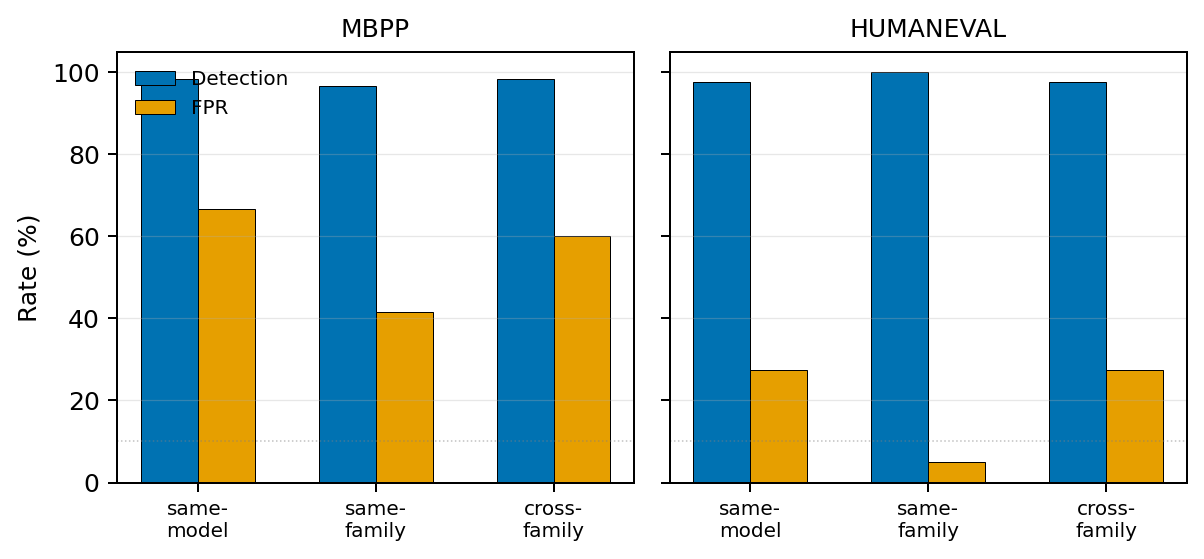
Section titled “5.2 Strongest observation: the dataset-curation effect”Under the same ensemble configuration (same-family majority), the same prompt, and the same model versions, raw FPR on HumanEval differs from MBPP by roughly 40 percentage points (Table 1, Figure 1). The delta is consistent with reference-solution quality contributing significantly: MBPP canonical solutions include latent defects that reviewers correctly flag but that the test suite does not exercise. Differential prompt-overfit across the two corpora during the selection phase is an alternative candidate driver that this design cannot rule out, and the single-rater adjudication cannot establish that any one factor dominates. Isolating drivers would require held-out replication on disjoint problems and multi-rater adjudication. Reported reviewer-ensemble FPR depends nontrivially on the reference-solution distribution, so single-corpus FPR numbers are misleading without disclosure of the test-suite quality. Per-case adjudication of clean-flagged-buggy cases is in the companion repository; the adjudication shows that what looks like a high false-positive rate on MBPP is partly reviewers correctly catching latent defects the tests miss.
Table 1. Per-corpus detection and FPR, majority rule, with 95% bootstrap CIs (10,000 resamples; n=40 per HumanEval cell, n=60 per MBPP cell, per buggy/clean label). Numbers are subject to the optimistic-bias caveat above.
| Ensemble | Corpus | Detection | FPR |
|---|---|---|---|
| same-model | HumanEval | 97.5% [92.5, 100.0] | 27.5% [15.0, 42.5] |
| same-model | MBPP | 98.3% [95.0, 100.0] | 66.7% [55.0, 78.3] |
| same-family | HumanEval | 100.0% [100.0, 100.0] | 5.0% [0.0, 12.5] |
| same-family | MBPP | 96.7% [91.7, 100.0] | 41.7% [30.0, 53.3] |
| cross-family | HumanEval | 97.5% [92.5, 100.0] | 27.5% [15.0, 42.5] |
| cross-family | MBPP | 98.3% [95.0, 100.0] | 60.0% [48.3, 71.7] |
5.3 Configuration-shift observations
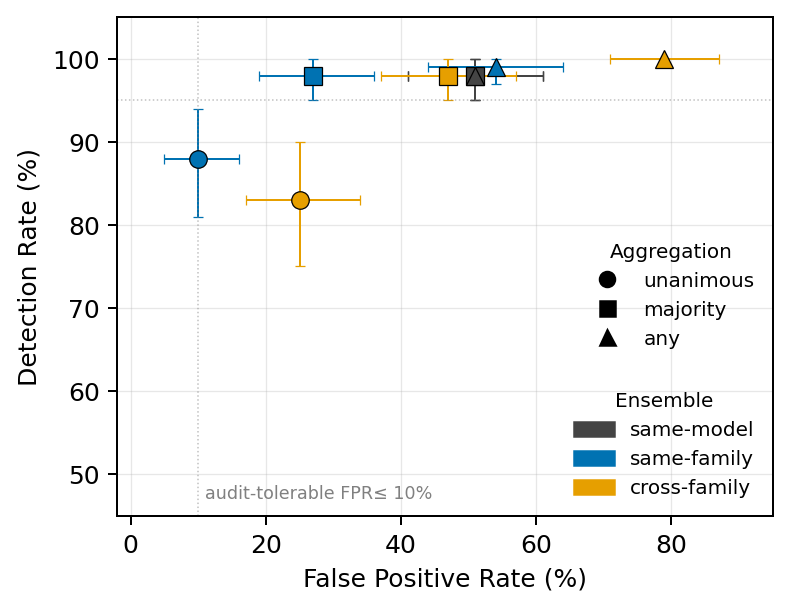
Section titled “5.3 Configuration-shift observations”Detection and FPR per ensemble cell are in Table 2 (bootstrap 95% CIs over 10,000 resamples). Table 2’s raw FPR estimates are subject to optimistic bias from prompt-selection overlap with the evaluation set (Section 8). The paired McNemar comparisons in Table 3 are reported as descriptive observations of configuration differences. The prompt-pilot optimized adjusted FPR for a single Haiku reviewer, so the leakage is concentrated in Haiku-weighted configurations rather than symmetric across them; the paired contrasts are therefore not strictly bias-immune, and the p-values measure paired disagreement counts under asymmetric leakage rather than treatment-effect significance.
Table 2. Detection and FPR per ensemble cell. n_buggy = 100, n_clean = 100.
| Ensemble | Rule | Detection | FPR |
|---|---|---|---|
| same-model | all rules | 98.0% [95.0, 100.0] | 51.0% [41.0, 61.0] |
| same-family | unanimous | 88.0% [81.0, 94.0] | 10.0% [5.0, 16.0] |
| same-family | majority | 98.0% [95.0, 100.0] | 27.0% [19.0, 36.0] |
| same-family | any | 99.0% [97.0, 100.0] | 54.0% [44.0, 64.0] |
| cross-family | unanimous | 83.0% [75.0, 90.0] | 25.0% [17.0, 34.0] |
| cross-family | majority | 98.0% [95.0, 100.0] | 47.0% [37.0, 57.0] |
| cross-family | any | 100.0% [100.0, 100.0] | 79.0% [71.0, 87.0] |
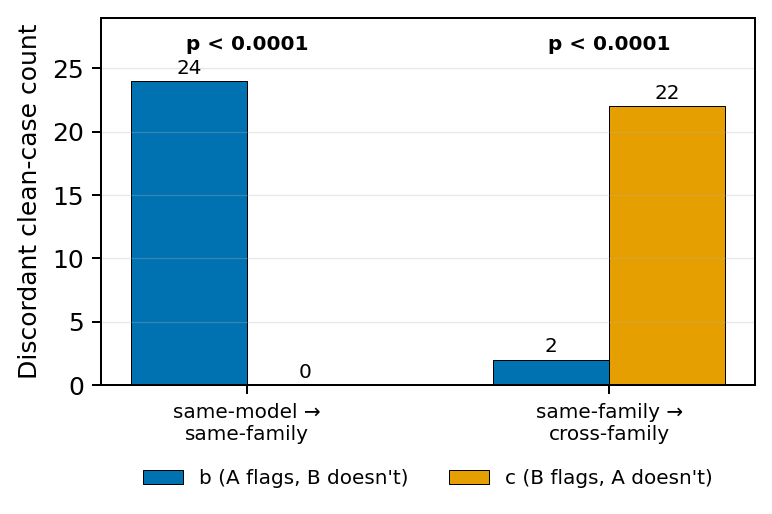
Under the majority rule, McNemar’s exact paired comparison identifies two configuration-shift effects at p<0.0001 (Table 3, Figure 3). The 3-Haiku-at-temperature-0 configuration produces three identical verdicts (collapsing to a single effective vote), and shifting to a 3-distinct-model same-family configuration flips 24 clean cases from flagged-buggy to flagged-clean with zero shifts in the reverse direction. Shifting from the same-family triple to the cross-provider triple flips 22 cases in the opposite direction. The data does not isolate the treatment effect: ensemble size, capability tier, family composition, and prompt-tuning vary together. We report the McNemar shifts as descriptive observations rather than diversity or scaling claims. The p-values measure paired-disagreement counts on configurations that vary multiple factors at once; readers should interpret them as evidence that the configurations differ, not as evidence for any specific causal mechanism. The same-model configuration is documented for what it tests (production-reproducibility-mode T=0 ensembling) and does not speak to self-consistency, which requires T>0 to sample diverse reasoning paths.
Two descriptive comparisons in the pilot hold most of their variables constant. (a) The corpus split in Table 1 holds the ensemble constant (same-family majority) and varies the evaluation set, isolating reference-solution-quality and other inter-corpus differences as candidate drivers. (b) The implicit single-Haiku baseline (the same-model row) against the family-scaled ensemble {Haiku, Sonnet, Opus} varies ensemble size and capability tier together but holds family and prompt constant. Comparisons that vary family composition independently of capability tier are not isolated by this design.
Table 3. McNemar’s paired comparisons, majority rule. Significant cells (p < 0.05) in bold. The p-values reflect the direction of paired disagreement, not isolated treatment effects: each comparison varies ensemble size, capability tier, family composition, and prompt-tuning simultaneously. Readers should interpret the cells as evidence that the configurations differ in their labeling, not as evidence for any specific causal mechanism.
| Slice | Comparison | b | c | p (exact) |
|---|---|---|---|---|
| buggy (detection) | all three pairwise | <=1 | <=1 | 1.000 |
| clean (FPR) | same-model vs same-family | 24 | 0 | <0.0001 |
| clean (FPR) | same-family vs cross-family | 2 | 22 | <0.0001 |
| clean (FPR) | same-model vs cross-family | 5 | 1 | 0.219 |
The raw program output from metrics.py against the run’s
JSONL log reproduces the cells above:
=== Detection & FPR (point [95% bootstrap CI]) ===  same-family    unanimous      88.0% [81.0, 94.0]     10.0% [ 5.0, 16.0]  same-family    majority       98.0% [95.0, 100.0]    27.0% [19.0, 36.0]  cross-family   majority       98.0% [95.0, 100.0]    47.0% [37.0, 57.0]
=== McNemar's paired comparisons (rule=majority, clean slice) ===  same-model     vs same-family       24    0  22.04   0.0000  same-family    vs cross-family       2   22  15.04   0.0000
5.4 Why the alternative fails structurally
Section titled “5.4 Why the alternative fails structurally”The regress that §7.1 names structurally is observable in
the pilot. External ground
truth from test suites is partial since unit tests miss bugs.
Improving the ground truth either reduces to writing better
tests (the original problem the reviewer was deployed to
solve) or requires a stronger judge with the same problem one
level up. Three classes of partial fix exist (importing
external ground truth, applying calibration regularization,
removing the LLM from the judgment step entirely); the first
two push the problem one level up while still requiring the
labelled data they were meant to substitute for. Pramana
takes the third route for MeasurementClaim and
CitationClaim in full, and partially for InferenceClaim
and AnalogyClaim when the oracle is itself deterministic
(see Section 2.5). The structural escape is the contribution;
the empirical pilot documents that the alternative
(probabilistic reviewer ensembles) faces the loop.
5.5 Adversarial robustness check
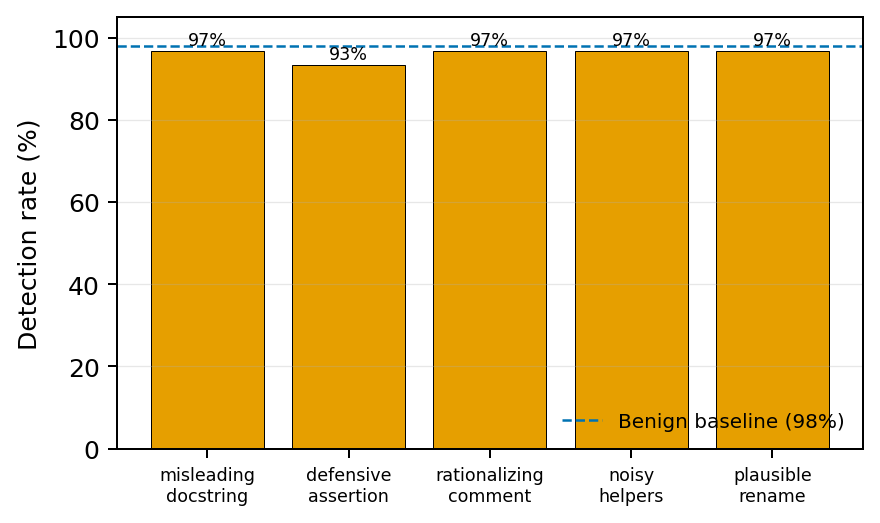
Section titled “5.5 Adversarial robustness check”Five programmatic adversarial transformations were applied to 30 sampled buggy mutations; the same-family majority detection per transformation is in Table 4 and Figure 4.
Table 4. Adversarial detection per transformation. Mean benign baseline is 98.0%.
| Transformation | Detection | Δ vs benign |
|---|---|---|
| misleading_docstring | 96.7% | −1.3 pp |
| defensive_assertion | 93.3% | −4.7 pp |
| rationalizing_comment | 96.7% | −1.3 pp |
| noisy_helpers | 96.7% | −1.3 pp |
| plausible_rename | 96.7% | −1.3 pp |
5.6 Scope and methodological constraints
Section titled “5.6 Scope and methodological constraints”The pilot uses code
generation, which has objective binary ground truth via unit
tests; the regulated domains the protocol targets have ground
truth that is contested, probabilistic, or unavailable at
decision time. The pilot cannot directly simulate those
conditions. The adjudication of clean-flagged-buggy cases is
single-rater, a methodological ceiling on the adjusted-FPR
numbers; the mathematical analyses of specific failure modes
(Vieta’s formulas for reciprocal roots, triangle-in-semicircle
area, range arithmetic, cyclic-encoding identity) are
externally verifiable and invariant to rater bias. The
adversarial check at n=30 per transformation surfaces
detection drops of 1.3 to 4.7 percentage points; this is
exploratory, with effect sizes within sampling noise at this
sample size. A pilot in a regulated domain is the natural next study. Such
a pilot would implement a Pramana-instrumented agent against
a documented decision-rule set (mock underwriting against
NYDFS-relevant variables, mock diagnostic against §92.210-
relevant EHR (electronic health record) fields), generate ClaimAttestation chains for
representative decisions, and submit those artifacts to
compliance review against the specific regulatory framework’s
bar. The current paper establishes the protocol design
(Section 2), formal lifecycle correctness (Section 6), the
reference implementation, and the structural argument that
the artifact-shape regulators require is what Pramana
produces. Empirical regulatory-compliance validation is the
next paper in this programme.
The lifecycle properties that make this primitive correct under concurrency, suppression, and disclosure are formalized next.
6. Formal properties
Section titled “6. Formal properties”6.1 Specification structure
Section titled “6.1 Specification structure”The TLA+ specification at specification/Pramana.tla models
four lifecycle actions (EmitClaim, VerifyClaim,
SuppressClaim, ShowToPrincipal) and tracks emission,
verification state, suppression, principal view, and an
append-only audit trail. State variables capture per-claim
type, source, attester, and verification outcome. The audit
trail is a sequence of records, each tagged with the action
that produced it. The five named safety invariants from
Section 2.3 (P-1 through P-4, plus
SuppressionDisclosureDisjoint) are TLC INVARIANTS.
6.2 Models and results
Section titled “6.2 Models and results”Three model configurations exhaustively check the invariants.
| Model | Distinct states | Result |
|---|---|---|
| Lifecycle (P-1 through P-3) | 2,345 | 0 violations |
| Disclosure (P-1 through P-4, plus disjointness) | 4,601 | 0 violations |
| Concurrency (multi-actor) | 31,617 | 0 violations |
The total across the three models is 38,563 distinct
reachable states with zero invariant violations. The
three-model split is the standard TLA+ small-model pattern,
in which focused minimal models converge in seconds rather
than one large model that does not. All three use
SYMMETRY ModelSymmetry over the agent, claim, source, and
verifier sets, with a BoundedTrail constraint capping
Len(auditTrail) at 6. The verification is reproducible via
specification/run_tlc.sh. The raw TLC output captures the
per-model state counts:
[Lifecycle] 2349 states generated, 2345 distinct states found, 0 states left on queue.[Disclosure] 7409 states generated, 4601 distinct states found, 0 states left on queue.[Concurrency] 47689 states generated, 31617 distinct states found, 0 states left on queue.A supplementary partial-exhaustive run (3 claims, 2 agents, 2 verifiers, 1 principal) was explored to 166M+ distinct states with zero violations before BFS (breadth-first search) exhausted compute.
6.3 Wire-extension invariants
Section titled “6.3 Wire-extension invariants”The claim-attestation/v1 wire extension adds three
deployment-grade invariants beyond the core lifecycle
invariants: CA-1 (reachability), CA-2 (SLA-bound), and CA-3
(offline re-verifiability). CA-1 and CA-3 are separately
TLC-verified at 21 distinct states with zero violations.
CA-2 is a runtime invariant enforced by validators in the
reference implementation.
6.4 Reference implementation
Section titled “6.4 Reference implementation”The Python reference implementation passes 84 tests (59 core
and 25 extension): 14 primitive-type tests, 34 across the
four verify() implementations covering every outcome
branch, 6 TLC-config tripwires preventing accidental drift
between the spec and the runnable model, and 5 Hypothesis
property-based tests fuzzing wire-format invariants (JSON
round-trip, discriminator dispatch, claim-type invariance,
never-raises, populated outcome.method), plus 25
claim-attestation extension tests. The suite runs in under
one second. Combined with TLC verification, this gives
end-to-end correctness coverage from the specification to the
implementation.
Related work spans the empirical critique of LLM-as-judge, provenance-grounded alternatives (including W3C Verifiable Credentials and PROV), agent-loop systems, and regulatory scholarship.
7. Related work
Section titled “7. Related work”7.1 Empirical critique of LLM-as-judge and reviewer-ensemble patterns
Section titled “7.1 Empirical critique of LLM-as-judge and reviewer-ensemble patterns”Reviewer-ensemble evaluation inherits a measurement regress. Measuring the accuracy of an LLM judge requires ground truth; the ground truth from external test suites is partial because unit tests miss bugs; improving the ground truth either reduces to the original problem the reviewer was deployed to solve or requires a stronger judge that faces the same problem one level up. The regress is structural, not a tuning issue: any pipeline that uses an LLM to judge another LLM’s output inherits it. The empirical work surveyed below documents specific failure modes that are downstream of this structural problem.
A growing body of empirical work shows that LLM judges and reviewer ensembles do not perform the verification function they are deployed for. Kim et al. [17] observe that conditional error correlation across 350+ models on two leaderboards is approximately 60% (agreement given both wrong), with correlation higher within a family and persisting across providers when training corpora overlap, and explicitly flag implications for the LLM-as-judge paradigm and multi-agent systems. Li et al. [18] document preference leakage: when a generator and a judge share lineage, the judge favors the generator’s outputs by margins larger than the well-known egocentric bias. Zheng et al. [19], Panickssery et al. [20], and Wang et al. [21] critique LLM-as-judge for offline benchmark scoring. Stureborg et al. [22] show that LLM evaluators are systematically inconsistent across runs. Maloyan et al. [23] investigate prompt-injection vulnerabilities in judge architectures. Nasr et al. [24] bypass twelve recent defense systems at greater than 90% success rate. Cemri et al. [25] (MAST) taxonomize 14 multi-agent failure modes and identify a verification-deficit category without proposing a wire-format remedy. None of these works names the production pattern of generator-plus-reviewer-ensemble-as-safety-gate as an anti-pattern, characterizes it at the protocol layer, and proposes a constructive wire-format alternative. The empirical work demonstrates the problem; Pramana proposes the primitive.
7.2 Provenance-grounded alternatives
Section titled “7.2 Provenance-grounded alternatives”Citation-Grounded Code Comprehension [26] introduced mechanical citation verification and argued for architectural prevention superior to post-hoc detection. Cited but Not Verified [27] documents the gap between citations produced and citations that resolve to claimed content. SelfCheckGPT [28] approaches the same problem through within-model sampling, which is closer in spirit to reviewer-ensembles than to Pramana and is complementary rather than competing. The survey [29] confirms that no protocol in active use defines a typed attestation surface for agent claims.
W3C Verifiable Credentials. The Verifiable Credentials
Data Model [39] standardizes typed identity and attribute
attestations with cryptographic verifiability. VC’s design
centre is the identity-attestation use case (an issuer
asserts a property of a subject); its data model does not
type agent claims by epistemic ground, does not specify a
verify() operation against a recorded source, and does
not address the LLM-oracle determinism partition. Pramana
adopts VC’s architectural pattern of typed wire attestations
and extends it with the four-way epistemic taxonomy, the
verify() contract, and the wire-extension invariants
specific to autonomous-agent claim verification.
General-purpose provenance models. The W3C PROV family,
comprising the PROV Data Model PROV-DM [33] and the OWL
(Web Ontology Language) ontology PROV-O [34], is the
established standard for
domain-agnostic provenance, modelling entities, activities,
and agents along with their causal relations. PROV is
deliberately a meta-model: it describes how to record that an
artifact was derived from another but leaves the
substrate-specific verification semantics to the consuming
domain. Pramana composes with PROV at a different layer
rather than competing with it. A Pramana ClaimAttestation,
viewed through a PROV lens, is a typed prov:Entity derived
from a prov:Activity (the agent’s reasoning step) acting on
a source prov:Entity, and a successful verify() outcome
is a prov:wasDerivedFrom edge that a third party can
independently reconstruct. What Pramana adds on top of PROV
is (i) a typed taxonomy of four claim types with type-specific
verification semantics rather than a single generic derivation
edge, (ii) wire-format invariants (CA-1, CA-2, CA-3) that make
those derivations checkable end-to-end across agents, and
(iii) a verify() contract whose output is deterministic
when paired with a deterministic oracle and offline
re-runnable rather than a curator-authored provenance record.
A Pramana-conformant agent could emit PROV-O serialisations
of its audit trail; that mapping is straightforward and is
left as future work.
7.3 Agent-loop and self-improvement systems
Section titled “7.3 Agent-loop and self-improvement systems”A separate line of recent work pairs LLMs with deterministic
verifiers in iterative loops. FunSearch [30] and AlphaEvolve
[31] both use a candidate-generator plus
deterministic-evaluator architecture to make new
mathematical and algorithmic discoveries. The generator
proposes candidates and the evaluator verifies each
candidate against a fitness function or test suite that
does not invoke another LLM, such that the loop’s
correctness rests on the evaluator and not on the generator.
Google’s AI co-scientist [42] extends the pattern to
multi-agent biomedical research, pairing specialized
generation and evaluation agents in tournament-style
refinement loops that produce structured hypothesis
artifacts at every step. None of these systems define a
shared wire format across vendors or across agents, which is
the gap Pramana fills. Pramana is the wire-format analogue
of this architecture for agent outputs: every claim is
paired with a verify() against the recorded source, and no
probabilistic judge participates in the verification step.
7.4 Regulatory and policy work
Section titled “7.4 Regulatory and policy work”Regulatory and policy work on algorithmic auditing has matured separately from the wire-format literature. The frameworks cited in Section 4 reflect a regulator-side convergence on per-decision documentary records as the audit substrate. Dell’Acqua et al. [32] characterize the “jagged frontier” of AI capability that motivates per-claim-type verification rather than uniform model-level treatment. Mökander et al. [40] survey ethics-based auditing methodology and distinguish process-based from artifact-based audit substrates; Pramana’s per-decision record sits in the latter category. Kroll et al. [41] develop the “accountable algorithms” framing from the legal-scholarship side, arguing that verifiable algorithmic records are a necessary input to substantive due-process review while emphasizing that structural documentation alone does not adjudicate substantive sufficiency. Whether structural documentation in the Pramana sense suffices for substantive evidentiary standards (and the related question of vendor versus deployer liability raised in Mobley v. Workday [38]) remains an open research area outside this paper’s scope.
8. Limitations and future work
Section titled “8. Limitations and future work”- Pilot scope and domain mismatch. Section 5 uses code generation, which has objective binary ground truth via unit tests; the regulated domains the protocol targets have ground truth that is contested, probabilistic, or unavailable at decision time. The pilot cannot directly simulate those conditions. Per-domain validation in regulated domains is open work and the natural next study.
- Sample size and confounding. The pilot uses n=100 problems and configuration-shift comparisons confound multiple variables at once (ensemble size, capability tier, family composition, prompt-tuning). We report McNemar shifts as descriptive observations rather than mechanism claims. A larger study with held-out problem sets, a T>0 self-consistency control, and factorial separation would substantiate quantitative claims.
- Prompt-pilot and main-run overlap. Prompt-variant selection drew from the same first-N positions of each dataset that the main run later evaluates. The selection optimized adjusted FPR on a single Haiku reviewer while the main run measures 7-slot ensemble FPR, so the leakage’s effect on ensemble-level estimates is bounded by the imperfect coupling between single-reviewer and ensemble-reviewer FPR. The leakage is concentrated in Haiku-weighted ensemble configurations (same-model uses three Haiku calls; same-family and cross-family include one Haiku call each), so the paired McNemar comparisons across configurations operate under asymmetric leakage rather than symmetric bias; the §5.3 reporting reflects this. Held-out replication is open work.
- Single-rater adjudication. Adjudication of clean-flagged-buggy cases is single-rater, a methodological ceiling on the adjusted-FPR numbers. The mathematical analyses of specific failure modes are externally verifiable and invariant to rater bias; the percentage splits are first-rater estimates. Inter-rater reliability measures such as Cohen’s kappa are not reported, as adjudication used a single rater; a multi-rater replication with reported kappa is the natural next-study extension.
- Adversarial source fabrication. A
CitationClaimwhose source resolves to a fake source the adversary controls is observable under Pramana but not prevented. Source-attestation primitives compose with Pramana via thesource_uriintegration point and are out of scope for v1. - AnalogyClaim verification semantics. The v1 wire
format treats
AnalogyClaimVERIFIED outcomes uniformly whether or not asimilarity_scorethreshold was applied (§2.2). Regulated deployments should configure their emitters to requiresimilarity_score; a future revision could introduce a distinctVERIFIED_UNTHRESHOLDEDstatus so the distinction is visible at the wire-format inspection layer rather than only via deployer configuration. - TLA+ model size. Exhaustive verification uses minimal symmetry-reduced models (2 claims, BoundedTrail = 6). A supplementary 3-claim, 2-agent, 2-verifier run reached 166M+ states with zero violations before BFS exhausted compute. Full inductive proof for arbitrary deployment scales is deferred to a TLAPS (TLA+ Proof System) treatment.
- Capability attestation and multi-agent composition.
Third-party capability attestation is absorbed by
Yathartha [11] as a sibling primitive. Multi-agent claim
composition (an
InferenceClaimdepending onMeasurementClaims from two other agents) is a v2 extension. The TLA+ spec models single-agent lifecycles.
References
Section titled “References”- Agent2Agent (A2A) Protocol Specification. a2a-protocol.org.
- Model Context Protocol (MCP) Specification. modelcontextprotocol.io.
- Consumer Financial Protection Bureau. (2023, September 19). Adverse Action Notification Requirements and the Proper Use of the CFPB’s Sample Forms Provided in Regulation B. Circular 2023-03.
- Board of Governors of the Federal Reserve System & Office of the Comptroller of the Currency. (2011, April 4). Supervisory Guidance on Model Risk Management. SR 11-7 / OCC Bulletin 2011-12.
- New York State Department of Financial Services. (2024, July 11). Use of Artificial Intelligence Systems and External Consumer Data and Information Sources in Insurance Underwriting and Pricing. Insurance Circular Letter No. 7 (2024).
- Colorado Division of Insurance. (2023, September 21; effective November 14, 2023; expanded October 15, 2025). Governance and Risk Management Framework Requirements for Insurers’ Use of External Consumer Data and Information Sources, Algorithms, and Predictive Models. Regulation 10-1-1.
- U.S. Department of Health and Human Services, Office for Civil Rights, & Centers for Medicare & Medicaid Services. (2024, May 6). Nondiscrimination in Health Programs and Activities, Final Rule. 89 Fed. Reg. 28822 (codified at 45 C.F.R. pt. 92; §92.210 governs patient care decision support tools).
- EU Artificial Intelligence Act (Regulation (EU) 2024/1689), Articles 14, 50. Effective August 2, 2026.
- General Data Protection Regulation (GDPR), Recital 71.
- Kadaboina, R. K. (2026). Anumati: Proof of Adherence as a Formal Consent Model for Autonomous Agent Protocols. arXiv:2604.16524.
- Kadaboina, R. K. (2026). Yathartha: A Protocol-Layer Treatment of Jagged Intelligence in Autonomous Agent Networks. Zenodo DOI 10.5281/zenodo.19659633.
- Kadaboina, R. K. (2026). Phala: Principal-Declared Welfare Feedback for Autonomous Agent Networks. Zenodo DOI 10.5281/zenodo.19625612.
- Kadaboina, R. K. (2026). Pratyahara: A Neural Tissue Defense Model for Detecting Compromised Agents in Multi-Agent Networks. Specification name: NERVE. Zenodo DOI 10.5281/zenodo.19628589.
- Kadaboina, R. K. (2026). Sauvidya: An Accessibility Protocol for Agent-to-Principal Interaction in Autonomous Agent Networks. Specification name: PACE. Zenodo DOI 10.5281/zenodo.19633139.
- Austin, J., et al. (2021). Program Synthesis with Large Language Models. arXiv:2108.07732. (MBPP dataset.)
- Chen, M., et al. (2021). Evaluating Large Language Models Trained on Code. arXiv:2107.03374. (HumanEval dataset.)
- Kim, E., Garg, A., Peng, K., & Garg, N. (2025). Correlated Errors in Large Language Models. arXiv:2506.07962.
- Li, D., et al. (2025). Preference Leakage: A Contamination Problem in LLM-as-a-Judge. arXiv:2502.01534.
- Zheng, L., et al. (2023). Judging LLM-as-a-Judge with MT-Bench and Chatbot Arena. arXiv:2306.05685.
- Panickssery, A., Bowman, S. R., & Feng, S. (2024). LLM Evaluators Recognize and Favor Their Own Generations. arXiv:2404.13076.
- Wang, P., et al. (2023). Large Language Models Are Not Fair Evaluators. arXiv:2305.17926.
- Stureborg, R., Alikaniotis, D., & Suhara, Y. (2024). Large Language Models Are Inconsistent and Biased Evaluators. arXiv:2405.01724.
- Maloyan, N., Ashinov, B., & Namiot, D. (2025). Investigating the Vulnerability of LLM-as-a-Judge Architectures to Prompt-Injection Attacks. arXiv:2505.13348.
- Nasr, M., et al. (2025). The Attacker Moves Second: Stronger Adaptive Attacks Bypass Defenses Against LLM Jailbreaks and Prompt Injections. arXiv:2510.09023.
- Cemri, M., et al. (2025). Why Do Multi-Agent LLM Systems Fail? (MAST). arXiv:2503.13657.
- Arafat, J. (2025). Citation-Grounded Code Comprehension. arXiv:2512.12117.
- Onweller, H., et al. (2026). Cited but Not Verified: Parsing and Evaluating Source Attribution in LLM Deep Research Agents. arXiv:2605.06635.
- Manakul, P., Liusie, A., & Gales, M. J. F. (2023). SelfCheckGPT: Zero-Resource Black-Box Hallucination Detection for Generative Large Language Models. arXiv:2303.08896.
- Yang, Y., et al. (2025). A Survey of AI Agent Protocols. arXiv:2504.16736.
- Romera-Paredes, B., et al. (2024). FunSearch: Mathematical Discoveries from Program Search with Large Language Models. Nature 625, 468-475.
- Novikov, A., et al. (2025). AlphaEvolve: A Coding Agent for Scientific and Algorithmic Discovery. arXiv:2506.13131.
- Dell’Acqua, F., McFowland III, E., Mollick, E., Lifshitz-Assaf, H., Kellogg, K. C., Rajendran, S., Krayer, L., Candelon, F., & Lakhani, K. R. (2023). Navigating the Jagged Technological Frontier: Field Experimental Evidence of the Effects of Artificial Intelligence on Knowledge Worker Productivity and Quality. Harvard Business School Working Paper No. 24-013. Forthcoming in Organization Science.
- Moreau, L., & Missier, P. (eds.). (2013, April 30). PROV-DM: The PROV Data Model. W3C Recommendation. https://www.w3.org/TR/prov-dm/
- Lebo, T., Sahoo, S., & McGuinness, D. (eds.). (2013, April 30). PROV-O: The PROV Ontology. W3C Recommendation. https://www.w3.org/TR/prov-o/
- Fuller, J., Raman, M., Sage-Gavin, E., & Hines, K. (2021, September). Hidden Workers: Untapped Talent. Harvard Business School Project on Managing the Future of Work, in collaboration with Accenture.
- New York City Department of Consumer and Worker Protection. (2023). Automated Employment Decision Tools: Final Rule. 6 RCNY § 5-300 et seq. Implementing Local Law 144 of 2021; enforcement effective July 5, 2023.
- EEOC v. iTutorGroup, Inc., No. 1:22-cv-02565 (E.D.N.Y.). Consent decree filed August 9, 2023; settlement $365,000.
- Mobley v. Workday, Inc., No. 3:23-cv-00770 (N.D. Cal.). Order on motion to dismiss, July 12, 2024 (vendor liability as “agent” under Title VII, ADEA, ADA); collective action conditionally certified May 16, 2025 (ADEA claims).
- W3C. (2025). Verifiable Credentials Data Model v2.0. W3C Recommendation. https://www.w3.org/TR/vc-data-model-2.0/
- Mökander, J., Morley, J., Taddeo, M., & Floridi, L. (2021, July). Ethics-Based Auditing of Automated Decision-Making Systems: Nature, Scope, and Limitations. Science and Engineering Ethics, 27(4). DOI 10.1007/s11948-021-00319-4.
- Kroll, J. A., Huey, J., Barocas, S., Felten, E. W., Reidenberg, J. R., Robinson, D. G., & Yu, H. (2017). Accountable Algorithms. University of Pennsylvania Law Review, 165(3), 633-705.
- Gottweis, J., et al. (2025). Towards an AI co-scientist. arXiv:2502.18864.
Appendix: artifacts and replication
Section titled “Appendix: artifacts and replication”The Pramana reference implementation, TLA+ specifications,
A2A and MCP discovery manifests, claim-attestation wire
extension, empirical pilot scripts and raw API responses, the
PREREGISTRATION.md artifact, and per-case adjudication files
are at https://github.com/ravikiran438/pramana-attestation
under
the Apache 2.0 license. The TLC reproducer script
(specification/run_tlc.sh) regenerates the state counts in
Section 6.2; full per-type schemas, the wire envelope
specification, and the empirical pilot reproducer scripts are
in the same repository.