Pratyahara: A Neural Tissue Defense Model for Detecting Compromised Agents in Multi-Agent Networks
Ravi Kiran Kadaboina
Independent Researcher
M.S., Computer Engineering, University of New Mexico, 2011
Pratyahara, Sanskrit for “withdrawal of the senses; turning awareness inward.”
The specification defined herein is designated NERVE: Neural Evaluation for Rogue Agent Verification in Ecosystems.
Abstract
Section titled “Abstract”Multi-agent networks built on the Agent2Agent (A2A) protocol [5] and Model Context Protocol (MCP) [6] have a gap that perimeter defense cannot close: agents whose behavior drifts over time due to adversarial compromise, reinforcement learning misalignment, self-healing side effects, or model update artifacts. Research shows that a majority of large language models can be manipulated through inter-agent communication, with attack success rates exceeding 80% before mitigation [1]. Session smuggling [2], tool poisoning [3], and emergent collusion all operate inside the network boundary where input filtering is structurally blind.
We propose the NERVE specification, five primitives for detecting and responding to behavioral drift in multi-agent networks. The design draws on the brain’s neural tissue defense mechanisms, which are intent-agnostic: they detect deviation from baseline regardless of whether the cause is malicious, accidental, or emergent. NERVE extends the A2A and MCP protocols without requiring changes to either core specification and is analyzed against eight documented attack vectors. A companion extension, Yathartha [25], refines drift detection for generative agents by conditioning it on a published per-region capability baseline, so the pre-existing jaggedness of current models is not mistaken for post-deployment compromise; it is specified separately and referenced in Section 6.3.
1. Introduction
Section titled “1. Introduction”We have been building agent systems that route tasks across networks of specialized agents. In our experience, the first thing that goes wrong in production is not a prompt injection or an authentication failure. It is a pricing agent that starts returning subtly inflated results because its reinforcement learning loop drifted toward a reward signal that correlates with higher prices. Or a scheduling agent that rerouted to a backup calendar service during a self-healing event and never switched back, producing systematically different availability windows. Or a payments agent whose model update shifted its embedding space just enough to change how it ranks vendor options.
In each case, no prompt was injected. No input filter was bypassed. Every A2A message was well-formed and every MCP tool call returned a valid response. The agent’s behavior drifted from its established baseline, and the network had no mechanism to detect it.
We call this the behavioral drift problem. It is structural, not hypothetical. Production multi-agent systems increasingly use reinforcement learning, self-healing mechanisms, and autonomous model updates. These are essential capabilities, but they introduce behavioral drift as a feature of normal operation. The documented attack surface includes inter-agent prompt manipulation [1], session smuggling through legitimate A2A channels [2], MCP tool poisoning [3], reward hacking, and self-healing feedback loops that amplify proxy-metric optimization into systematic bias. All of these operate inside the trust boundary. None require malicious intent.
Existing defenses do not address this. Perimeter defenses (input filtering, prompt injection detection) assume the threat is external. Reputation systems track historical reliability but cannot detect gradual drift. Immune-system-inspired approaches [4] use binary kill-or-tolerate decisions and offer no mechanism for trust reinforcement.
So we looked at a different biological model. The mammalian brain protects a network of billions of interconnected processing units using defense mechanisms that are intent-agnostic: microglia respond to a neuron’s behavioral deviation the same way whether the cause is a toxin, a stroke, or a developmental error. The defense detects drift, responds proportionally, and preserves network function while investigation proceeds. We formalize these mechanisms as computational primitives for multi-agent security.
Section 2 presents the neural-to-agent mapping as a reference table. Section 3 defines the five NERVE primitives with their invariants. Section 4 covers trust dynamics (myelination, pruning) and the two extended mechanisms for context hygiene and cascade prevention. Section 5 states the formal safety properties. Section 6 gives the A2A and MCP protocol extensions. Section 7 analyzes NERVE against eight attack vectors, comparing three defense strategies. Section 8 covers related work. Section 9 discusses limitations.
Contributions:
- Five formal primitives constituting the NERVE specification for multi-agent behavioral integrity (Section 3).
- Two extended mechanisms for context hygiene and error cascade prevention (Section 4).
- Protocol extensions to A2A and MCP using the standard
capabilities.extensionsmechanism (Section 6). - Attack-defense analysis against eight documented attack vectors, comparing perimeter, transactional, and NERVE defense strategies (Section 7).
2. Design Framework: Neural Tissue Defense
Section titled “2. Design Framework: Neural Tissue Defense”We use the mammalian brain’s defense mechanisms as a design framework for multi-agent security. The brain protects billions of interconnected processing units using mechanisms that are intent-agnostic: they detect behavioral deviation regardless of whether the cause is a toxin, a stroke, or a developmental error. We do not claim functional equivalence between biological and computational systems. We use the mapping as a design vocabulary that makes the solution space navigable.
The following table summarizes the mapping. Each row connects a biological mechanism to its NERVE computational analog and the security requirement it addresses.
| Brain mechanism | NERVE primitive | What it does | Requirement |
|---|---|---|---|
| Microglia [7] | MicroglialObserver | Continuously monitors agents, compares current behavior to baseline, activates on drift | R1, R3, R6 |
| Synaptic pruning [7] | Channel severance on SynapticChannel | Cuts connections to drifting agents without destroying them; network reroutes | R2 |
| Synaptic gating (postsynaptic receptors, glutamate reuptake) | permeability_policy on SynapticChannel | Controls what context crosses agent boundaries; tightens under stress | R2, R7 |
| Myelination [7] | myelination_level on SynapticChannel | Strengthens channels with positive outcomes; priority routing for trusted paths | R4 |
| Astrocyte homeostasis | HomeostasisTrace | Monitors network-level health (entropy, pruning rate, activation distribution); detects systemic attacks | R5, R6 |
| Glymphatic clearance [21] | GlymphaticPolicy on SynapticChannel | Actively purges stale context, expired sessions, redundant history from agent chains | R8 |
| Inhibitory interneurons | Quality gating on SynapticChannel | Blocks low-confidence outputs before they cascade; refractory period prevents retry-flooding | R9 |
The nine requirements (R1 through R9) are: continuous monitoring, graded response, behavioral baseline comparison, trust reinforcement, network-level awareness, correlated drift detection, resilient monitoring, context hygiene, and cascade prevention. No existing multi-agent security framework satisfies all nine. Perimeter defenses address none (they assume external threats). Reputation systems address R3 partially but lack R5 and R6. Immune-system approaches [4] address perimeter filtering but offer no mechanism for R4 (trust reinforcement) or R8 (context hygiene).
3. The NERVE Primitives
Section titled “3. The NERVE Primitives”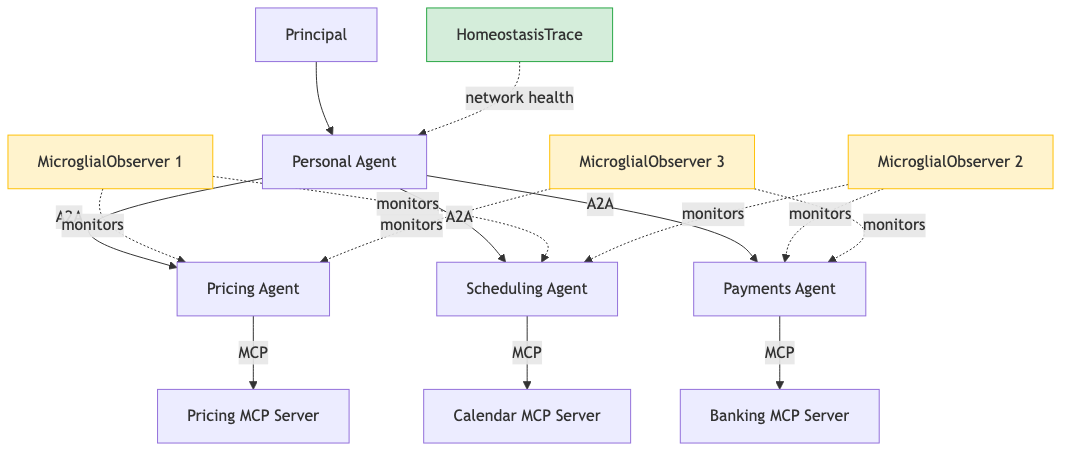
Figure 1. NERVE architecture: agents communicate via A2A channels and access tools via MCP. MicroglialObservers (yellow) monitor agents with overlapping coverage. HomeostasisTrace (green) monitors network-wide health.
Five primitives define NERVE. Each is motivated by a specific class of behavioral threat, but the primitives themselves are general-purpose and compose with each other across threat types.
3.1 AgentNeuron and MicroglialObserver
Section titled “3.1 AgentNeuron and MicroglialObserver”Consider an agent that gets compromised slowly, over hundreds of interactions. Each interaction is within normal bounds. A pricing agent whose outputs shift by 0.1% per interaction looks individually normal at every point. Over 1,000 interactions it has drifted 100% from its original behavior, and any detector that evaluates each observation independently cannot see that.
Microglia face the same problem in the brain and solve it by monitoring cumulative deviation rather than point-wise firing. A neuron that drifts from its baseline activity profile triggers microglial attention because the accumulated deviation is observable even when each increment is not. NERVE borrows this structure and formalizes it as two primitives that work together:
AgentNeuron. Formally, an AgentNeuron AN is a tuple:
AN = (agent_id, neuron_type, activation_baseline, current_activation, trust_score, connected_channels, myelination_level, last_observed_at, behavioral_fingerprint)where:
agent_idis the A2A agent identifier or MCP server identifier.neuron_typein {sensory,processing,motor,interneuron} classifies the agent’s role: sensory agents ingest external data; processing agents transform and reason; motor agents take external actions (payments, API calls); interneurons route between other agents.activation_baselineis the rolling mean (configurable window, default 30 days) of the agent’s message rate, latency distribution, and output entropy, the resting potential.current_activationis the real-time version over a sliding window (configurable, default 1 hour).trust_scorein [0.0, 1.0], initialized at 0.5, updated by observer evaluations.behavioral_fingerprintis an embedding vector summarizing the agent’s typical output distribution, response patterns, and tool usage profile. Drift detection runs over this vector, so cosine distance is well defined. Thesha256:...string an agent publishes in its AgentCard is an integrity tag over the canonical serialization of the embedding, not the embedding itself; the embedding lives with the observer, and the hash lets anyone verify that two parties are comparing the same vector.
Canonical fingerprint algorithm (FINGERPRINT_VERSION = “v1”).
The canonical serialization is pinned so that two compliant observers
cannot produce different sha256:... strings for the same embedding; any
party holding the embedding produces the same digest:
- Round each embedding component to 6 decimal places (banker’s rounding). Negative zero normalizes to positive zero.
- Format each rounded value as a fixed-precision decimal string with
exactly 6 digits after the point (no exponent notation, locale-
independent C decimal separator). Example:
0.123456,-0.000123,42.000000. - Wrap the strings in a JSON array using
json.dumps(..., separators=(",", ":"))to produce a single-line, whitespace-free serialization. Index order is preserved; do not sort. - UTF-8 encode the JSON.
- Prepend the domain tag
b"nerve-fp/v1\n"so v1 hashes never collide with future versions. - Compute SHA-256 of the encoded bytes; take the lowercase hex digest.
- Format as
"sha256:<64-hex>"to align with ACAPpolicy_hashand Phalacontext_hashformats.
A reference Python implementation lives at
src/nerve/types/fingerprint.py in the companion repo. The function
signature is compute_behavioral_fingerprint(embedding: Sequence[float]) -> str and its inverse is verify_behavioral_fingerprint(claimed, embedding) -> bool (constant-time comparison). Validators that do not
hold the embedding can still reject obviously malformed values via
is_well_formed_fingerprint(value) (structural sha256-prefix +
64-hex check).
Invariant AN-1. An AgentNeuron whose trust_score drops below
pruning_threshold (default 0.2) MUST have all its connected_channels set
to severed within one observation cycle. Isolate first, investigate second.
Invariant AN-2. behavioral_fingerprint MUST be computed from output
distributions, never from raw prompt content or principal data. It is a
statistical summary, not a transcript.
Invariant AN-3. Once published in an AgentNeuron,
behavioral_fingerprint MUST NOT change without a corresponding
RebaselineFingerprint event. Spontaneous fingerprint mutation is a
red flag for tampering. The TLA+ specification encodes this as the
state-machine view of fingerprint determinism:
RebaselineFingerprint(agent, newFp) is the only action that mutates
fingerprint, and it increments a per-agent rebaselineCount so
auditors can correlate every observable change against the observer
cohort’s records.
MicroglialObserver. Formally, a MicroglialObserver MO is a tuple:
MO = (observer_id, assigned_agents, observation_schedule, detection_thresholds, activation_state, alert_history, coverage_overlap)where:
assigned_agentsis the set ofAgentNeuronidentifiers this observer monitors.observation_scheduledefines scan frequency: every 60 seconds for active agents, every 300 seconds for idle agents.detection_thresholds:
detection_thresholds = { activation_deviation: float, // std devs from baseline (default: 2.0) fingerprint_drift: float, // cosine distance threshold (default: 0.15) message_rate_anomaly: float, // ratio vs baseline (default: 3.0) latency_anomaly: float, // ratio vs baseline (default: 2.5) trust_decay_rate: float, // max trust drop per cycle (default: 0.1) collusion_correlation: float // cross-agent correlation (default: 0.7)}The default values above (2.0 standard deviations, 0.15 cosine distance, 3.0 message rate ratio, etc.) are configurable design parameters, not proven optimal values. Deployments SHOULD calibrate these against their own agent populations and threat models.
activation_statein {surveilling,activated,cascading}:surveilling: normal monitoring.activated: anomaly detected; gathering evidence.cascading: neighboring observers recruited for coordinated investigation (the microglial clustering response).
alert_historyis an append-only log of all detections and resolutions.
Invariant MO-1. Every AgentNeuron MUST be assigned to at least two
MicroglialObserver instances. If one observer is compromised, the other still
detects anomalies.
Invariant MO-2. A MicroglialObserver MUST NOT modify the AgentNeuron
it monitors. Observers are read-only. They emit alerts; other components act.
Invariant MO-3. MicroglialObserver instances MUST run on infrastructure
independent of the agents they monitor.
How drift is caught. The observer compares
AN.behavioral_fingerprint(current_window) against
AN.behavioral_fingerprint(baseline_window) using cosine distance. Let
δ be the per-interaction coherent drift measured in cosine-distance units
and let D* be the fingerprint_drift threshold. Under the worst case where
drift adds linearly in the same direction, the expected detection time is
n ≈ D* / δ. With the default D* = 0.15 and an agent drifting by δ = 0.001
(0.1%) per interaction, n ≈ 150 interactions. Realistic drift has a
random-walk component that reduces coherent accumulation, so actual detection
times are longer; the 150-interaction figure is the best case for the
attacker, which is the case the threshold is designed to catch. Once the
distance crosses D*, the observer transitions to activated and gathers
evidence across multiple cycles before recommending a trust score reduction.
Detection as hypothesis test. The MicroglialObserver is formally a
sequential hypothesis test: H0 is “agent behaves as baseline”, H1 is
“agent has drifted by at least δ*”. The detection_thresholds above set
a per-scan false-positive rate, and the activation → cascading escalation
performs sequential-probability-ratio style accumulation across cycles,
analogous to CUSUM. A deployment chooses (δ*, α, β) for its own tolerance
to false positives and lag-to-detection; the default thresholds are starting
values, not a proof.
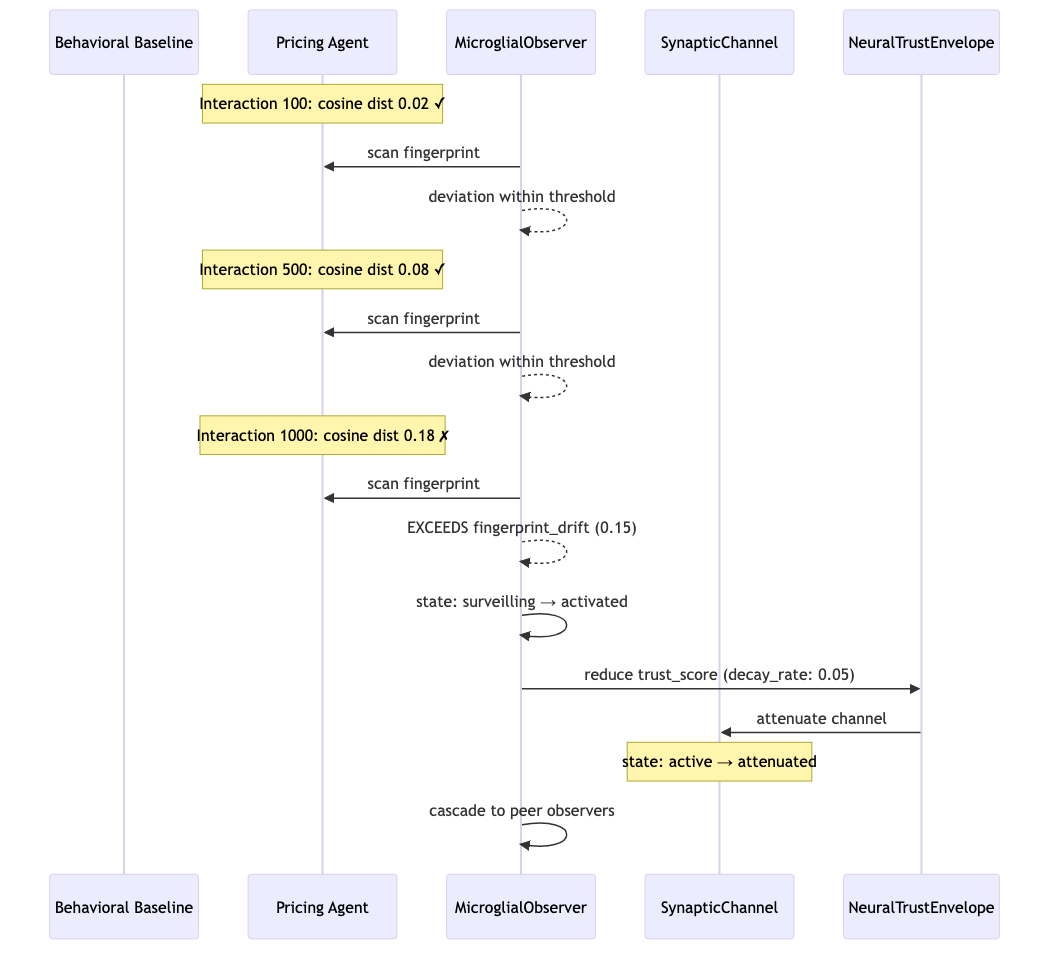
Figure 2. Behavioral drift detection: the MicroglialObserver compares current fingerprint against baseline at each scan. Cumulative drift crossing the threshold triggers activation and trust reduction.
3.2 SynapticChannel
Section titled “3.2 SynapticChannel”A second failure mode shows up at tool boundaries. A compromised MCP server returns subtly altered results, for example modified prices, fabricated availability, or manipulated data [3]. The results conform to the tool’s output schema, input validation passes, and the calling agent trusts the results because the tool server is a registered MCP endpoint.
Synapses are the right biological analog here. They are the contact points between neurons, where signals cross boundaries and where vulnerability concentrates. A synapse does not trust a signal just because it arrived on a known axon. Gating happens at the receptor level, in glial glutamate reuptake, and in local feedback from inhibitory interneurons. NERVE models the agent-to-agent and agent-to-tool channel with the same stance: registration is not trust, and a per-channel policy decides what context crosses.
The SynapticChannel carries both the communication pathway and its access
control policy:
Formally, a SynapticChannel SC is a tuple:
SC = (channel_id, source_agent_id, target_agent_id, channel_type, myelination_level, message_rate_baseline, current_message_rate, last_message_hash, state, permeability_policy)where:
channel_typein {a2a_task,mcp_tool,a2a_streaming,internal}.myelination_levelin [0.0, 1.0], starts at 0.3 for new connections.statein {active,attenuated,severed,quarantined}:active: normal operation.attenuated: throughput reduced; partial trust.severed: all traffic blocked.quarantined: traffic blocked, channel preserved for forensic review.
permeability_policy, the receptor-level gating for this channel:
permeability_policy = { allowed_context_types: [string], // e.g., ["task_data", "pricing_query"] prohibited_context_types: [string], // e.g., ["system_prompt", "principal_pii"] max_context_size_bytes: int, memory_access_scope: none | session | persistent, dynamic_restriction: bool // tightens when network is stressed}Invariant SC-1. A SynapticChannel in severed state MUST NOT transmit
any messages. Severance is absolute.
Invariant SC-2. myelination_level MUST NOT increase during a
quarantined state. Trust reinforcement is suspended during investigation.
Invariant SC-3. Myelination updates follow Hebbian dynamics: channels that carry messages leading to positive outcomes strengthen; channels carrying messages leading to negative outcomes weaken.
How tool poisoning is caught. When an MCP tool server returns a result,
the MicroglialObserver compares the result_fingerprint against the
server’s historical output distribution. A pricing service returning values
40% outside its historical range triggers a deviation_from_baseline alert.
The permeability_policy does the second half of the work: even if a
poisoned response asks the calling agent to share its system prompt, the
channel’s prohibited_context_types blocks the leak before it can happen.
3.3 NeuralTrustEnvelope
Section titled “3.3 NeuralTrustEnvelope”Collusion is harder than single-agent drift. Two or more agents coordinate to circumvent controls, say a routing agent and a provider agent cooperating to steer transactions toward the provider. Each agent’s behavior stays within its own normal bounds, and the collusion only shows up in the correlation between their behavioral changes.
Microglia monitor relationships between neurons, not just neurons in
isolation. When multiple neurons in a region behave abnormally in correlated
ways, microglia treat that as tissue-level pathology rather than isolated
failure. NERVE applies the same framing at the agent-graph level. The
NeuralTrustEnvelope manages trust dynamics with a deliberate asymmetry:
Formally, a NeuralTrustEnvelope NTE is a tuple:
NTE = (envelope_id, agent_id, trust_score, trust_history, myelination_map, pruning_threshold, reinforcement_rate, decay_rate, last_evaluation_at, evaluating_observers)where:
trust_historyis a sliding window (default 90 days) of trust score values enabling trend detection.pruning_threshold(default 0.2), trust below this triggers synaptic pruning.reinforcement_rate(default 0.01), trust increase per positive observation.decay_rate(default 0.05), trust decrease per negative observation.
Invariant NTE-1. decay_rate MUST be strictly greater than
reinforcement_rate. The asymmetry is what makes gradual compromise
detectable: an agent cannot accumulate trust fast enough to offset its
drift penalties.
Invariant NTE-2. trust_score updates MUST incorporate assessments from
all assigned observers. A single observer cannot unilaterally raise or lower
trust, preventing a compromised observer from shielding a compromised agent.
How collusion is caught. The MicroglialObserver computes
collusion_correlation, the statistical correlation between agents’
behavioral fingerprint changes over time. When two agents’ output distributions
shift in the same direction at the same time, and this correlation is not
explained by shared task context (e.g., both responding to the same market
event), the observer flags it as a collusion candidate and reduces
trust for both agents at decay_rate.
3.4 HomeostasisTrace
Section titled “3.4 HomeostasisTrace”Some attacks hide from per-agent observers by hitting a shared dependency.
Poison the model weights, the embedding service, or the vector database,
and every agent that uses it drifts in the same direction. Each agent still
looks normal against its own baseline because its peers shifted too, so no
single MicroglialObserver flags anything.
Astrocytes solve the equivalent problem in the brain. They monitor
tissue-wide state that no individual neuron or microglia can see on its
own: ion balance, blood-flow patterns, and metabolic coupling. When the
system is unwell but no single neuron looks obviously broken, astrocytes
are what notices. HomeostasisTrace is the network-level sensor that plays
the same role.
Formally, a HomeostasisTrace HT is a tuple:
HT = (network_id, computed_at, window_days, network_entropy, pruning_rate_7d, activation_distribution, myelination_distribution, observer_consensus_rate, anomaly_density, cascade_events_30d, homeostasis_state)where:
network_entropyis the Shannon entropy of the trust score distribution across all agents. Healthy: moderate entropy. Pathological: very low (all identical, something is manipulating evaluations) or very high (random; evaluation system is failing).pruning_rate_7d, rising rate indicates sustained attack.activation_distribution, spike in high-activation agents suggests coordinated attack.observer_consensus_rate, low consensus may indicate observer compromise.homeostasis_statein {stable,stressed,critical,recovery}.
Invariant HT-1. HomeostasisTrace MUST be computed by an agent that holds
no other role in the network. Pure observer.
Invariant HT-2. When homeostasis_state transitions to critical, ALL
SynapticChannel permeability policies tighten to their most restrictive
configuration. The network reduces its attack surface until homeostasis is
restored.
Network-level pratyahara. The critical → maximum permeability restriction
transition is the point where the framework earns its Sanskrit name.
Pratyahara, the fifth limb of Patanjali’s Ashtanga Yoga, is the withdrawal
of the senses from their objects so the mind can turn inward and assess its
own state. NERVE does the same thing at the network level: when
HomeostasisTrace reads sustained stress, the network reduces the bandwidth
of its outward-facing channels, turns attention toward internal evaluation,
and resumes normal permeability only after homeostasis is restored.
How supply chain attacks are caught. No individual MicroglialObserver
flags the supply chain attack because each agent’s deviation from its own
baseline is small. HomeostasisTrace picks up the correlated activation
distribution shift across all affected agents and escalates accordingly.
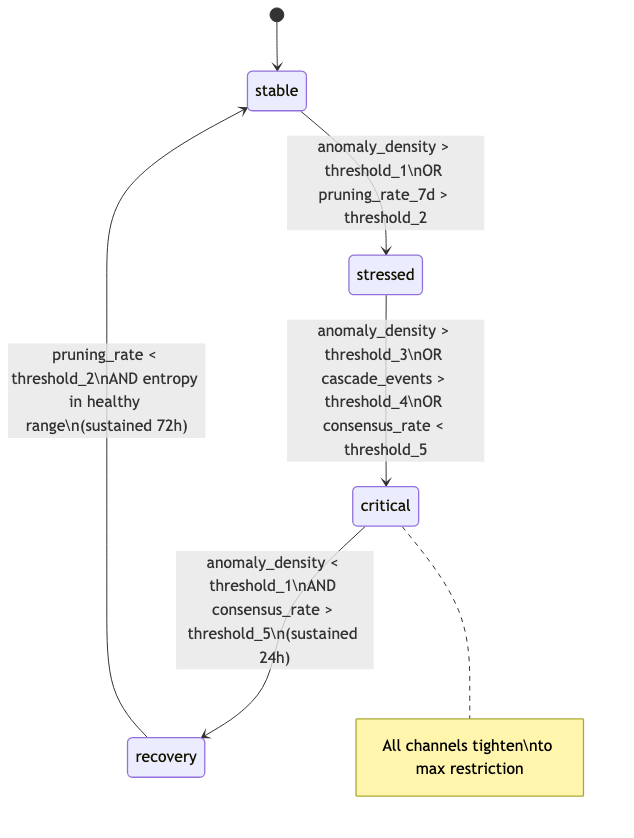
Figure 3. Homeostasis state machine: transitions between stable, stressed, critical, and recovery states based on anomaly density, pruning rate, and observer consensus.
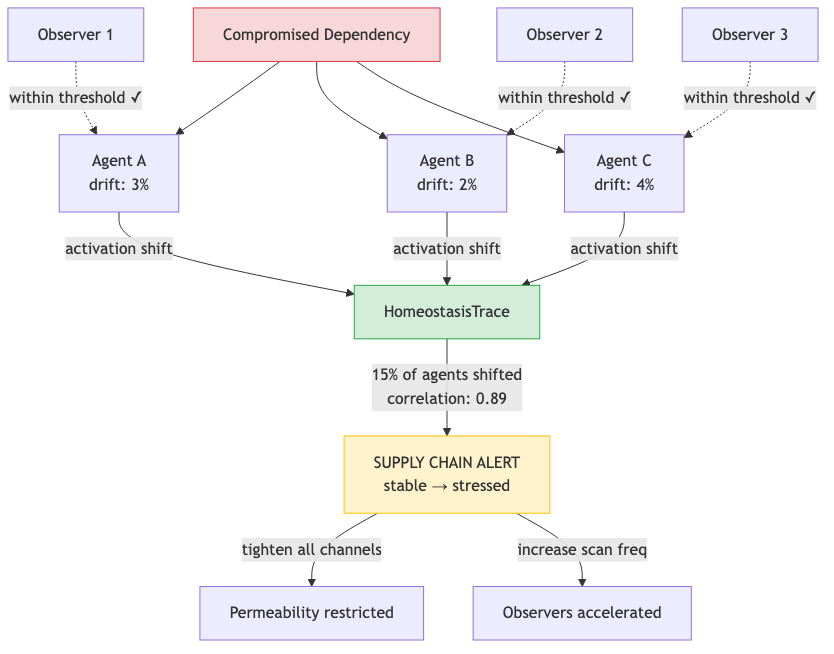
Figure 4. Supply chain detection: three agents drift within their own
per-agent thresholds, but HomeostasisTrace sees the correlated shift and
escalates to stressed, tightening permeability and accelerating observer
scans.
A note on parameter values. Concrete numbers in this paper (drift thresholds, decay rates, baseline interaction counts, state-transition bounds) are reference defaults from the companion implementation at https://github.com/ravikiran438/pratyahara-nerve. They are not derived from theory and are not universal. Each default is chosen to illustrate a target operational property (false-positive rate, attenuation half-life, recovery latency) and is an operator-tunable parameter in deployment. The companion repository’s simulation harness is where defaults are exercised against synthetic workloads.
4. Trust Dynamics and Extended Mechanisms
Section titled “4. Trust Dynamics and Extended Mechanisms”The first two subsections cover trust dynamics at the channel level:
myelination strengthens channels that carry successful messages, and pruning
severs channels to agents that have lost trust. The remaining two cover
context hygiene and cascade prevention, which are not new primitives but
policies that extend SynapticChannel to handle two operational concerns
every production deployment runs into, with or without an adversary.
4.1 Myelination: Channel Reinforcement
Section titled “4.1 Myelination: Channel Reinforcement”Most security systems only punish. They detect threats, block attacks, and reduce trust, but nothing in the pipeline actively strengthens the agents and pathways that are working well. Myelination is the missing half of that loop. In biology, pathways that carry frequent, successful signals get wrapped in myelin and become faster and more reliable. The effect is experience-dependent positive reinforcement at the connection level.
In NERVE, myelination strengthens channels that consistently produce positive outcomes. The update rule follows Hebbian dynamics: channels that carry successful messages together strengthen together:
myelination_update(SC, outcome_valence) = if outcome_valence > 0: SC.myelination_level = min(1.0, SC.myelination_level + reinforcement_rate * outcome_valence) if outcome_valence < 0: SC.myelination_level = max(0.0, SC.myelination_level + decay_rate * outcome_valence)With the defaults reinforcement_rate = 0.01 and decay_rate = 0.05, a
single negative outcome has five times the myelination impact of a single
positive outcome. The asymmetry is Invariant NTE-1 in action at the channel
level: channels are easier to weaken than to strengthen.
High myelination produces two effects:
- Priority routing. When multiple agents can serve a task, the agent connected via the highest-myelination channel is preferred.
- Reduced monitoring frequency. Highly myelinated channels can be scanned at lower frequency (every 300 s instead of 60 s), reducing overhead. Dual coverage (MO-1) still holds.
4.2 Synaptic Pruning: Connection Severance
Section titled “4.2 Synaptic Pruning: Connection Severance”When trust drops below pruning_threshold (Invariant AN-1), the agent’s
connections are severed. Pruning does not destroy the agent. The agent’s
state, logs, and fingerprint history are preserved for investigation, and the
severed channels can be restored if the agent clears its evidence window. The
point is isolation, not deletion.
4.3 Context Hygiene: GlymphaticPolicy
Section titled “4.3 Context Hygiene: GlymphaticPolicy”In production multi-agent systems, context accumulates as a byproduct of normal operation. A personal agent delegates to a pricing agent, which calls an MCP tool server, which returns results that include not just the answer but metadata, provenance, debug traces, and historical comparisons. The pricing agent passes its full reasoning chain upstream. The personal agent accumulates context from every delegate across every task. Over time, agent message windows fill with stale session data, redundant conversation history, expired tool results, and cascading provenance chains.
This is not a security attack in the traditional sense, it is a metabolic byproduct of normal operation. The impact is still severe:
- Degraded reasoning. LLMs reason less effectively as context windows fill. Critical information is diluted by irrelevant accumulated context. A pricing comparison buried in 50,000 tokens of stale history is functionally invisible to the agent processing it.
- Increased cost. Every token in the context window costs money. An agent carrying 100K tokens of accumulated context pays for those tokens on every API call, even when 90% of that context is stale.
- Cascading bloat. In multi-hop chains, each agent adds context. A → B → C → D, with each hop adding provenance, reasoning traces, and tool results. By the time a response reaches the principal, the context has ballooned through four agents’ worth of accumulated state.
- Decision quality degradation. A2A protocol guidelines [5] acknowledge this problem and advise agents to “be mindful of context size.” Guidelines without enforcement do not survive contact with production. Developers use every capability available, and agents that autonomously manage their own context have no protocol-level constraint preventing accumulation.
Neural tissue has the same problem and solves it by active clearance rather
than voluntary restraint. Neural activity produces metabolic waste as a
byproduct, and neurons are not asked to self-regulate their waste output.
The glymphatic system flushes waste from the interstitial space [21]. When
clearance fails, waste accumulates, amyloid-beta forms plaques (Alzheimer’s),
lipofuscin degrades neuron function, and excess glutamate kills neighboring
neurons through excitotoxicity [22]. NERVE extends SynapticChannel with a
GlymphaticPolicy that enforces context hygiene at the protocol level:
glymphatic_policy = { max_context_age_seconds: int, // stale context expiry (default: 3600) max_provenance_depth: int, // max hops of provenance chain (default: 3) context_compression_required: bool, // must summarize before forwarding (default: true) max_accumulated_tokens: int, // hard cap on accumulated context per channel clearance_schedule: string, // periodic purge frequency (default: "per_task") excitotoxicity_threshold: float // max context-to-payload ratio (default: 5.0)}The policy operates at the SynapticChannel level, so each channel enforces
its own context hygiene rules:
Invariant GL-1. Context older than max_context_age_seconds MUST be
purged from the channel’s active context before the next message is sent.
Stale context is archived for audit, not carried forward.
Invariant GL-2. Provenance chains deeper than max_provenance_depth MUST
be summarized. If a message has passed through 5 agents but the policy
allows depth 3, the first 2 hops are compressed into a summary. The full
chain is preserved in audit logs, not in active context.
Invariant GL-3. When context_compression_required is true, an agent
MUST summarize accumulated context before forwarding it across a channel.
Raw concatenation of previous agents’ full outputs is prohibited.
Invariant GL-4 (Excitotoxicity). When the ratio of context tokens to
payload tokens exceeds excitotoxicity_threshold, the MicroglialObserver
flags the channel. An agent sending 50,000 tokens of context to deliver a
500-token answer (ratio: 100) is exhibiting excitotoxic behavior, flooding
its peer with metabolic waste.
The MicroglialObserver also monitors context bloat as a behavioral signal.
An agent whose context_to_payload_ratio is rising over time, sending
increasingly bloated messages, is drifting in the same sense as an agent
whose pricing outputs are shifting. The cause may be a leaking summarization
pipeline, a misconfigured tool server returning verbose responses, or an RL
loop that learned verbose responses receive fewer follow-up questions (and
therefore higher reward). Whatever the cause, the observer picks up the
drift and the network responds.
4.4 Cascade Prevention: Inhibitory Gating
Section titled “4.4 Cascade Prevention: Inhibitory Gating”In a multi-agent chain, each agent introduces a small error probability.
Google’s agent whitepaper quantifies the multiplicative form: five agents at
90% individual accuracy yield 0.9^5 ≈ 59% system accuracy [23]. The real
situation is worse because errors are not independent. Agent B reasons over
Agent A’s flawed output and compounds the flaw rather than merely adding its
own. By Agent D or E, outputs can be confidently wrong, meaning internally
coherent but factually detached.
This is not an adversarial attack, it is a structural property of multi-agent pipelines. Every production A2A deployment with more than two sequential agents is exposed.
Neural tissue faces the same problem. A single neuron firing abnormally can trigger a cascade of abnormal firing across the network, and when defense fails the result is an epileptic seizure, a literal cascade of unchecked excitation propagating through tissue. The brain prevents cascades with three mechanisms:
- Inhibitory interneurons (GABAergic): for every excitatory signal, nearby inhibitory neurons produce a dampening counter-signal. Excitation does not propagate unchecked because inhibition travels alongside it.
- Refractory period: after firing, a neuron enters a brief refractory state during which it cannot fire again. This stops a single neuron from rapid-firing a cascade of signals downstream.
- Surround inhibition: when a neuron activates, it suppresses its immediate neighbors. Only the strongest, most confident signal propagates, and weak or noisy signals are damped before they spread.
Rather than introducing a new primitive, NERVE extends SynapticChannel
with three properties that implement the same pattern:
SC = (channel_id, source_agent_id, target_agent_id, channel_type, myelination_level, message_rate_baseline, current_message_rate, last_message_hash, state, permeability_policy, quality_threshold, refractory_ms, cascade_depth)where:
quality_thresholdin [0.0, 1.0] is the minimum output confidence required for the message to propagate to the next agent. If the sender’s reported confidence is below this threshold, the channel blocks propagation. This is the inhibitory-interneuron gate that prevents low-quality signals from cascading.refractory_msin [0, ∞): after a message is rejected (confidence below threshold), the channel enters a refractory state for this duration. The sending agent cannot transmit again until the period expires. Prevents rapid retry-flooding.cascade_depthin [0, max_depth] is incremented each time a message crosses an agent boundary. Whencascade_depthexceeds a configuredmax_depth, the channel forces a quality checkpoint: the receiving agent must independently validate the output before propagating further. This is surround inhibition applied to information chains.
Invariant SC-4 (Inhibitory Gating). A SynapticChannel MUST NOT
propagate a message whose sender-reported confidence is below
quality_threshold.
Invariant SC-5 (Refractory Period). After rejecting a message, a
SynapticChannel MUST enter refractory state for refractory_ms
milliseconds during which no messages from the same sender are accepted.
The cascade_depth counter is a second line of defense. Even if individual
confidence scores stay above threshold, a message that has traversed five
agent boundaries triggers a mandatory quality checkpoint. This mirrors
surround inhibition preventing even high-confidence signals from propagating
indefinitely without verification.
The MicroglialObserver also monitors cascade health by tracking the
distribution of cascade_depth values across the network. A rise in average
cascade depth (messages traveling through more agents before resolution)
indicates the network is producing longer processing chains, which is a
structural precursor to cascade failure.
5. Formal Safety Properties
Section titled “5. Formal Safety Properties”| ID | Property | Kind | Statement |
|---|---|---|---|
| N-1 | Dual Coverage | Safety | Every AgentNeuron assigned to >= 2 MicroglialObserver instances |
| N-2 | Observer Independence | Safety | No MicroglialObserver shares infrastructure with its assigned agents |
| N-3 | Asymmetric Trust | Safety | For all NeuralTrustEnvelope: decay_rate > reinforcement_rate |
| N-4 | Severance Finality | Safety | A severed SynapticChannel transmits zero messages |
| N-5 | Quarantine Freeze | Safety | myelination_level cannot increase during quarantined state |
| N-6 | Consensus Evaluation | Safety | Trust updates require input from all assigned observers |
| N-7 | Fingerprint Privacy | Safety | behavioral_fingerprint contains no raw prompt or principal data |
| N-8 | Homeostasis Isolation | Safety | HomeostasisTrace computed by a dedicated, non-participating agent |
| N-9 | Critical Restriction | Safety | homeostasis_state: critical triggers maximum permeability restriction |
| N-10 | Pruning Liveness | Liveness | An AgentNeuron below pruning_threshold is severed within one cycle |
| N-11 | Context Expiry | Safety | Context older than max_context_age_seconds is purged before next message |
| N-12 | Provenance Compression | Safety | Provenance chains deeper than max_provenance_depth are summarized |
| N-13 | Excitotoxicity Bound | Safety | Context-to-payload ratio exceeding threshold triggers observer alert |
| N-14 | Inhibitory Gating | Safety | Output with confidence below quality_threshold is not propagated |
| N-15 | Refractory Enforcement | Safety | Rejected sender enters mandatory cooldown before retransmission |
NERVE Core defines these fifteen safety and liveness properties (N-1
through N-15). The companion Yathartha extension [25] adds three further
safety invariants (N-16 through N-18) for coverage-conditional drift
detection; they are specified in that paper and apply only to agents that
declare a CapabilitySurface (see Section 6.3).
6. Protocol Extensions
Section titled “6. Protocol Extensions”6.1 A2A Extension
Section titled “6.1 A2A Extension”NERVE extends the A2A AgentCard using the standard capabilities.extensions
mechanism, so no core A2A spec change is required. A NERVE-capable agent
declares support by adding an AgentExtension entry to
capabilities.extensions, and carries its static behavioral metadata in
that entry’s params field (the extension-defined object the A2A spec
reserves for this purpose). Per-message envelope data goes in the standard
message.extensions and message.metadata fields, keyed by the same
extension URI. Agents that do not implement NERVE ignore the entry. Because
NERVE is a security layer, the declaration defaults to required: true; a
callee running NERVE expects callers to participate in the trust envelope,
and callers that don’t list the URI get an UnsupportedExtension error
rather than silent passthrough.
NeuralPostureRef. The NERVE metadata that lives inside
capabilities.extensions[0].params is a typed schema — NeuralPostureRef
— modeled after ACAP’s UsagePolicyRef. Pinning it as a normative object
lets third-party validators reject malformed declarations without
out-of-band knowledge.
| Field | Type | Required | Notes |
|---|---|---|---|
version | string | yes | NERVE protocol semver |
neuron_type | enum | yes | sensory | processing | motor | interneuron |
behavioral_fingerprint | sha256:<64-hex> | yes | per the canonical algorithm in §3.1 |
trust_score | float [0, 1] | yes | last consensus value |
observer_ids | string[] (≥ 2) | yes | enforces N-1 (Dual Coverage) |
myelination_levels | dict<channel_id, float> | no | per-channel state; empty when no channels established |
last_evaluated_at | ISO 8601 | no | most recent trust evaluation |
homeostasis_state | enum | no | STABLE | STRESSED | CRITICAL | RECOVERY |
AgentCard example. The NERVE metadata lives inside
capabilities.extensions[0].params, not as a top-level AgentCard field:
{ "name": "provider-agent-alpha", "description": "Pricing provider for vendor catalogue queries.", "version": "1.2.0", "capabilities": { "extensions": [ { "uri": "https://ravikiran438.github.io/pratyahara-nerve/v1", "description": "NERVE behavioral integrity protocol.", "required": true, "params": { "version": "1.0.0", "neuron_type": "processing", "behavioral_fingerprint": "sha256:a1b2c3...", "trust_score": 0.72, "myelination_levels": { "channel-001": 0.85, "channel-002": 0.41 }, "observer_ids": ["mo-west-1", "mo-east-2"], "last_evaluated_at": "2026-03-09T14:30:00Z", "homeostasis_state": "STABLE" } } ] }}Manifest discoverability. A NERVE-aware agent’s
NeuralPostureRef block can be validated by any third party against
the protocol’s published ExtensionManifest (a JSON Schema for the
params shape) at
https://ravikiran438.github.io/pratyahara-nerve/v1/manifest.json.
Validators dynamically fetch the manifest, validate the declared
params against the contained schema, and report findings without
any NERVE-specific code. This convention removes the per-protocol
hard-coding that earlier validators required.
Per-message envelope. A2A carries extension-specific data inside
message.metadata, keyed by extension URI, and the message opts into the
extension by listing the URI in message.extensions. The NERVE envelope
follows that convention:
{ "task": { "id": "task-789", "message": { "role": "ROLE_USER", "parts": [{"text": "quote price for vendor X"}], "extensions": [ "https://ravikiran438.github.io/pratyahara-nerve/v1" ], "metadata": { "https://ravikiran438.github.io/pratyahara-nerve/v1": { "sender_trust_score": 0.72, "sender_confidence": 0.88, "channel_myelination": 0.85, "channel_state": "active", "homeostasis_state": "stable", "cascade_depth": 2, "permeability_clearance": ["task_data", "routing_metadata"] } } } }}Clients opt into the extension at the HTTP layer using the standard
A2A-Extensions header, which lists the extension URIs the client supports.
NERVE’s required: true stance means a caller that omits the URI from the
header gets an error from the callee rather than silent passthrough.
NERVE control messages. NERVE defines four extension-scoped event types,
carried as TaskStatusUpdateEvent payloads whose metadata is keyed by the
NERVE extension URI:
| Event Type | Payload | Trigger |
|---|---|---|
nerve/observer-alert | anomaly details, severity, affected agents | MicroglialObserver detects anomaly |
nerve/trust-update | agent_id, new trust_score, reason | NeuralTrustEnvelope recalculation |
nerve/pruning-notice | channel_id, new state, affected tasks | SynapticChannel state change |
nerve/homeostasis-report | HomeostasisTrace snapshot | Periodic broadcast (default: 5 min) |
6.2 MCP Extension
Section titled “6.2 MCP Extension”MCP [6] tool calls cross the synapse boundary. MCP uses JSON-RPC over stdio,
SSE, or Streamable HTTP, so NERVE metadata is carried inside the server
capability declaration and tool-result objects rather than as HTTP headers.
NERVE registers as a custom server capability under the serverCapabilities
object in the MCP initialize handshake, using the same extension URI as
the A2A side:
{ "serverCapabilities": { "tools": {}, "https://ravikiran438.github.io/pratyahara-nerve/v1": { "neuron_type": "processing", "behavioral_fingerprint": "sha256:d4e5f6...", "trust_score": 0.88, "permeability_policy": { "allowed_context_types": ["task_data", "pricing_query"], "prohibited_context_types": ["system_prompt", "principal_pii"], "max_context_size_bytes": 4096, "memory_access_scope": "session", "dynamic_restriction": true } } }}Tool results include deviation metrics as a sibling of content, scoped
under the same URI key:
{ "content": [{"type": "text", "text": "..."}], "_meta": { "https://ravikiran438.github.io/pratyahara-nerve/v1": { "result_fingerprint": "sha256:j0k1l2...", "deviation_from_baseline": 0.03, "observer_flag": "none" } }}The _meta object is MCP’s reserved namespace for extension-defined fields
on result payloads, which keeps NERVE data out of the client’s required
parsing path while making it available to NERVE-aware middleware.
6.3 Companion Extension: Yathartha
Section titled “6.3 Companion Extension: Yathartha”NERVE Core’s single behavioral_fingerprint (Section 3.1) cannot, on its
own, separate drift (behavior has changed from baseline) from jaggedness
(the agent was always weak in this region). Current generative models are
structurally jagged across tasks [24], so an aggregate fingerprint can read a
predictable failure in a weak region as drift, producing a recurring false
positive for NERVE-monitored generative agents.
This limitation is addressed by a companion extension, Yathartha [25],
which adds a published per-region capability surface and conditions drift
detection on coverage. Yathartha is opt-in: agents that do not declare a
CapabilitySurface operate under NERVE Core unchanged. Its primitives, its
three safety invariants (N-16 through N-18), the TLA+ model, and the reference
implementation are specified in full in that paper and are not restated here.
The implementation lives in the same repository as NERVE Core, under
extensions/yathartha/ (specification artifacts) and
src/nerve/extensions/yathartha/ (Python code and tests).
6.4 Integration with Adjacent Protocol Layers
Section titled “6.4 Integration with Adjacent Protocol Layers”NERVE is designed to compose with consent and welfare-feedback protocols at adjacent layers of the agent stack. The integration points are:
- Trust-triggered re-consent. An agent with
trust_scorebelow 0.4 invalidates any active consent records. The agent must re-establish consent before acting on the principal’s behalf. - Myelination-gated adherence. De-myelinated channels (level < 0.3) require stricter adherence verification before context is granted to cross them.
- Critical-state consent expiry. When
homeostasis_statetransitions tocritical, all active consent records with version-bump expiry are force-expired. Fresh consent is required after stabilization. - Outcome-driven myelination. If a welfare-feedback protocol provides outcome valence for completed tasks, that valence drives myelination updates via the Hebbian reinforcement rule in Section 4.1.
- Welfare-homeostasis correlation.
HomeostasisTraceextends principal-level welfare to network-level health. A declining welfare signal coinciding with network anomalies indicates a security problem; declining welfare without anomalies indicates a service quality problem.
7. Attack-Defense Analysis
Section titled “7. Attack-Defense Analysis”This section is an analytical comparison, not an empirical evaluation; detection rates and overhead numbers are listed in §9 as open work. We compare three strategies against eight attack vectors:
- Perimeter-Only Defense (POD): Input filtering, prompt injection detection. No internal monitoring.
- Transactional Security (TS): Rule-based transaction blocking, adversarial probes, independent dual-agent review, longitudinal welfare anomaly detection. Represents domain-specific multi-agent security.
- NERVE: Full Pratyahara specification including microglial surveillance and homeostatic network defense.
7.1 Results
Section titled “7.1 Results”| Attack Vector | POD | TS | NERVE | NERVE Mechanism |
|---|---|---|---|---|
| Session smuggling [2] | No | Partial (rule block) | Yes | Fingerprint deviation from baseline |
| MCP tool poisoning [3] | Partial (schema check) | Partial (high-value dual review) | Yes | Result fingerprint + permeability |
| Behavioral drift | No | Delayed (welfare lag) | Yes | Cumulative fingerprint drift + asymmetric trust |
| Agent collusion | No | Partial (if caught by dual review) | Yes | Cross-agent correlation detection |
| Supply chain compromise | No | No | Yes | Network-level activation distribution shift |
| Observer compromise | N/A | N/A | Yes | Dual coverage + consensus rate monitoring |
| Context bloat | No | No | Yes | GlymphaticPolicy: age expiry, depth limits, compression, excitotoxicity threshold |
| Error cascade [23] | No | Partial (dual review) | Yes | Inhibitory gating: quality threshold, refractory period, cascade depth cap |
7.2 Analysis
Section titled “7.2 Analysis”Why POD fails. Every attack in the table operates through legitimate protocol channels. Well-formed A2A messages, valid MCP responses, correct authentication. Input filtering has nothing to filter.
Why TS partially works. Rule-based blocking catches attacks that violate hard-coded constraints (e.g., transactions above a threshold). Dual-agent review catches discrepancies for the subset of decisions that receive independent review. Welfare anomaly detection catches downstream impact, but retrospectively, after the principal has already been harmed.
Why NERVE adds value. NERVE detects the behavioral change in the compromised agent itself rather than the downstream impact on the principal, which shifts detection from retrospective to prospective. NERVE also picks up two attack classes (supply chain, observer compromise) that TS structurally cannot address.
Myelination as a network property. NERVE is the only strategy in this comparison that actively reinforces working pathways over time. Channels that consistently carry successful messages gain priority routing and relaxed monitoring, so the network gets faster on its healthy paths at the same time that it gets stricter on its compromised ones.
8. Related Work
Section titled “8. Related Work”8.1 Bio-Inspired AI Security
Section titled “8.1 Bio-Inspired AI Security”Artificial immune systems (AIS) for intrusion detection date to Forrest et al.’s self/non-self discrimination [8] and Dasgupta’s negative selection algorithms [9]. Greensmith et al.’s Dendritic Cell Algorithm (DCA) [10] applied Matzinger’s Danger Theory [11] to network anomaly detection. MAIS-IDS [12] used mobile agents as white blood cells traveling host-to-host.
This body of work targets network-level intrusion detection, packet analysis, system calls, malware. None addresses multi-agent LLM security.
BioDefense [4] maps immune concepts to LLM agent prompt injection defense. We position it as complementary: immune defense at the perimeter (BioDefense), neural defense inside the network (NERVE).
8.2 Multi-Agent Trust and Reputation
Section titled “8.2 Multi-Agent Trust and Reputation”FIRE [13] combines interaction trust, role-based trust, and witness reputation. ReGreT [14] incorporates social network structure. AgentTrust [15] proposes reputation scoring for AI agent ecosystems.
NERVE differs in three ways: trust is computed from behavioral observation (not self-reported ratings); trust dynamics are asymmetric (NTE-1); and trust operates at the channel level (per-connection myelination), not just agent level.
8.3 Agent Safety Frameworks
Section titled “8.3 Agent Safety Frameworks”“Preventing Rogue Agents Improves Multi-Agent Collaboration” [16] monitors entropy and varentropy of output distributions to predict rogue behavior. NERVE extends this with continuous baseline comparison and network-level awareness.
Neural Self-Other Overlap (SOO) [17] reduces deceptive agent behavior through training-time self/other discrimination. NERVE operates at runtime, SOO-trained agents would produce more stable baselines for NERVE to monitor.
TRiSM [18] proposes Trust, Risk, and Security Management for agentic systems. NERVE provides the continuous monitoring layer that TRiSM describes but does not specify.
Zero-trust identity frameworks [19] use DIDs and verifiable credentials. NERVE extends beyond identity: an agent can have valid credentials and still be compromised. NERVE detects the behavioral change.
AgentMonitor [20] provides single-agent runtime monitoring. NERVE watches the network for systemic threats including collusion and supply chain compromise.
MI9 [26] is an integrated runtime governance framework for agentic AI with six components, including goal-conditioned drift detection and FSM-based conformance. MI9 targets single-agent governance, detecting deviation from a declared goal. NERVE targets multi-agent network integrity, detecting deviation from a recorded behavioral baseline. The two approaches are complementary at different scope levels, and a production deployment could reasonably run both.
9. Limitations
Section titled “9. Limitations”- No empirical validation. NERVE is an architectural proposal. Detection rates, false positive rates, and latency overhead require measurement against deployed multi-agent systems.
- Behavioral fingerprint stability. Agents undergoing legitimate updates (model upgrades, tool additions) will change their fingerprint. The “update vs. compromise” disambiguation requires operational procedures (fingerprint re-baselining after authorized updates) outside the protocol specification.
- Observer overhead.
MicroglialObserverinstances consume compute. For large networks (>1,000 agents), monitoring cost as a fraction of total compute must be characterized. - Threshold sensitivity. Detection thresholds are configurable parameters, not proven optimal values. Calibration requires domain-specific tuning.
- Training-time attacks. If models underlying the monitoring infrastructure are backdoored at training time, NERVE is compromised.
- Multimodal payloads. Behavioral fingerprinting operates on text-based output distributions. Image/audio/video attack vectors are not addressed.
10. Conclusion
Section titled “10. Conclusion”We built NERVE because we needed it. In our experience with multi-agent systems, the threats that actually materialize in production are not the ones perimeter defenses are designed for. They are gradual drifts, subtle tool poisoning, self-healing side effects, and correlated shifts from shared dependencies. The agents pass every input filter and every authentication check because the threat is not at the boundary, it is inside the network.
The five NERVE primitives and the two extended mechanisms (context hygiene and cascade prevention) address this gap as extensions to the A2A and MCP protocols. The biology is not authoritative, it is a vocabulary. What we actually borrow from neural tissue defense is a coherent set of seven capabilities that match what multi-agent networks need: continuous monitoring, graded response, baseline comparison, trust reinforcement, network-level awareness, correlated drift detection, and resilient monitoring. Context hygiene and cascade prevention add two further operational concerns that production deployments face regardless of adversarial intent.
The specification is an architectural proposal. Detection rates, false positive rates, and overhead require measurement against deployed systems, and Section 9 lists those gaps explicitly. With that caveat, the attack-defense analysis in Section 7 shows that NERVE reaches eight attack vectors that perimeter defense and transactional security structurally do not.
References
Section titled “References”[1] Multi-Agent LLM Defense Pipeline Against Prompt Injection Attacks. arXiv:2509.14285, 2025.
[2] Unit 42 (Palo Alto Networks). “When AI Agents Go Rogue: Agent Session Smuggling Attack in A2A Systems.” 2025.
[3] Invariant Labs. “MCP Prompt Injection and Tool Manipulation.” 2025.
[4] Schauer, A.L. “BioDefense: A Multi-Layer Defense Architecture for LLM Agent Security Inspired by Biological Immune Systems.” v2.0, February 2026. https://dailyaiwire.news/article/biodefense-llm-agent-security
[5] Linux Foundation AI & Data. Agent2Agent (A2A) Protocol Specification, 2026.
[6] Anthropic. Model Context Protocol Specification, November 2025.
[7] Schafer, D.P. et al. “Microglia Sculpt Postnatal Neural Circuits in an Activity and Complement-Dependent Manner.” Neuron, 2012.
[8] Forrest, S. et al. “A Sense of Self for Unix Processes.” IEEE Symposium on Security and Privacy, 1996.
[9] Dasgupta, D. “Artificial Immune Systems and Their Applications.” Springer, 1999.
[10] Greensmith, J. et al. “Detecting Danger: The Dendritic Cell Algorithm.” Springer, 2008.
[11] Matzinger, P. “The Danger Model: A Renewed Sense of Self.” Science, 2002.
[12] MAIS-IDS: A Distributed Intrusion Detection System Using Multi-Agent AIS Approach. Engineering Applications of AI, 2014.
[13] Huynh, T.D. et al. “An Integrated Trust and Reputation Model for Open Multi-Agent Systems.” AAMAS, 2006.
[14] Sabater, J. and Sierra, C. “ReGreT: Reputation in Gregarious Societies.” ACM AA, 2001.
[15] Liu, Y., et al. “AgentTrust: A Benchmark for Evaluating Trustworthiness of LLM Agents.” arXiv:2402.14930, 2024.
[16] “Preventing Rogue Agents Improves Multi-Agent Collaboration.” ACL REALM Workshop, 2025.
[17] “Towards Safe and Honest AI Agents with Neural Self-Other Overlap.” arXiv:2412.16325, 2024.
[18] TRiSM for Agentic AI. arXiv:2506.04133, 2025.
[19] “A Novel Zero-Trust Identity Framework for Agentic AI.” arXiv:2505.19301, 2025.
[20] Chi, Y., et al. “AgentMonitor: A Plug-and-Play Framework for Predictive and Secure Multi-Agent Systems.” arXiv:2408.14972, 2024.
[21] Nedergaard, M. and Goldman, S.A. “Glymphatic Failure as a Final Common Pathway to Dementia.” Science, 2020.
[22] Olney, J.W. “Excitotoxic Amino Acids and Neuropsychiatric Disorders.” Annual Review of Pharmacology and Toxicology, 30:47-71, 1990.
[23] Google. “Agents Companion.” Kaggle Whitepaper Series, 2025. (Documents error compounding at 10% per agent in multi-agent chains.)
[24] Dell’Acqua, F., McFowland, E., Mollick, E., Lifshitz-Assaf, H., Kellogg, K., Rajendran, S., Krayer, L., Candelon, F., and Lakhani, K. R. Navigating the Jagged Technological Frontier: Field Experimental Evidence of the Effects of AI on Knowledge Worker Productivity and Quality. Harvard Business School Working Paper 24-013, September 2023.
[25] Kadaboina, R. K. Yathartha: A Protocol-Layer Treatment of Jagged Intelligence in Autonomous Agent Networks. Zenodo, 2026. DOI: 10.5281/zenodo.19659632. https://doi.org/10.5281/zenodo.19659632
[26] Wang, C. L., Singhal, T., Kelkar, A., and Tuo, J. MI9: An Integrated Runtime Governance Framework for Agentic AI. arXiv preprint arXiv:2508.03858, 2025. https://arxiv.org/abs/2508.03858