Phala: Principal-Declared Welfare Feedback for Autonomous Agent Networks
Ravi Kiran Kadaboina
Independent Researcher
M.S., Computer Engineering, University of New Mexico, 2011
Phala is Sanskrit for “fruit” or “the outcome of action.”
Abstract
Section titled “Abstract”Autonomous agent protocols define rich entry conditions for action: authentication establishes who may act; consent models establish under what conditions a permitted action may be taken. Neither addresses what happens after an action resolves: whether the outcome served the principal, and whether the agents involved should behave differently next time. We formalize this as the outcome gap. We further identify a structural inversion at the heart of existing feedback mechanisms: in every current protocol-layer system that routes outcome signals (reinforcement learning from human feedback at training time, multi-agent reward models, and advertising-oriented context protocols), the service provider defines what a good outcome means. The principal does not.
We propose five primitives that together constitute a principal-declared
welfare feedback protocol for agent-to-agent networks: OutcomeEvent
(objective facts of task resolution), SatisfactionRecord (quality signal),
BeliefUpdate (derived weight adjustment, privacy-preserving by invariant),
PrincipalSatisfactionModel (per-context, principal-authored declaration of what
good means for the principal), and WelfareTrace (longitudinal welfare
signal that modulates the learning rate of the entire network based on
whether the principal is gaining or losing autonomy over time). We
instantiate the model as extensions to the Agent2Agent (A2A) protocol and
the Model Context Protocol (MCP).
1. Introduction
Section titled “1. Introduction”AI agents are deployed at scale inside enterprise systems. Measurement of their value is not. This pattern is observed repeatedly across enterprise deployments. Teams integrate retrieval-augmented generation pipelines, model context servers, and multi-agent routing layers into production workflows. The integrations ship. Whether they improve outcomes for the people using them (whether they reduce task completion time, lower error rates, decrease cognitive load) is treated as a post-launch concern. In practice it is never revisited. The agents run. Whether they run well is inferred from the absence of complaints.
This is not an organizational failure. It is a structural gap in the agent protocol stack. Protocols for agent communication define rich lifecycle semantics: tasks are submitted, worked, completed or failed. They define how authentication tokens are validated, how policy claims are evaluated before action, how results are returned as structured artifacts. They define everything about the call except whether the call was worth making.
The gap has a specific shape. Consider a personal agent that monitors a user’s time-sensitive obligations and nudges them at the predicted optimal moment. The agent has a model of when the user is receptive and updates that model through experience. But on what signal? Current agent protocols provide no mechanism for the resolution of a downstream task to propagate back as a learning signal to the upstream agents that initiated it. Each task completes into a void.
There is a subtler problem beneath the routing gap. Every existing protocol-layer mechanism that propagates outcome signals (reinforcement learning from human feedback (RLHF) at training time, multi-agent reinforcement learning (MARL) reward functions, advertising context protocols) defines what a good outcome means in terms chosen by the service provider or the researcher. The principal, the human on whose behalf the agent acts, has no protocol-level mechanism to declare their own satisfaction weights. An agent nudging a user about a grocery pickup optimizes for task completion because that is what its reward model measures. Whether the user felt the nudge was timely, useful, or stressful is not represented anywhere in the protocol. This is the welfare inversion: the feedback loop is closed in the direction of the service provider, not the principal.
Phala addresses both problems. This paper makes four contributions:
- A formal account of the outcome gap and the welfare inversion as distinct structural deficits in current agent protocols, and why neither can be closed by logging infrastructure or training-time reward models alone (§2).
- A five-primitive outcome model in which the principal, not the service
provider, declares what a good outcome means. The
PrincipalSatisfactionModelgoverns valence computation; theWelfareTracemeasures whether the principal is gaining or losing autonomy over time and modulates the network’s learning rate accordingly (§3). - Concrete instantiations as extensions to A2A [1] and MCP [2], with wire-level protocol extensions for both (§4).
- A precise differentiation from the closest protocol-layer prior art, the IAB Tech Lab User Context Protocol, showing that the two protocols operate at the same layer but with structurally opposed incentive models (§6).
The model is agent-agnostic. Any agent network that implements the five primitives gains a principal-controlled feedback path, regardless of whether its constituent agents are built on large language models (LLMs), rules, or hybrid designs.
2. Two Gaps, Not One
Section titled “2. Two Gaps, Not One”2.1 The Outcome Gap
Section titled “2.1 The Outcome Gap”The A2A protocol defines a multi-state task lifecycle (submitted,
working, input-required, completed, failed, canceled) [1].
Completion carries artifacts but no signal about whether those artifacts
served the principal. A task
can complete successfully (no exception was raised, the artifact was
delivered) while producing zero value to the person on whose behalf it
ran. The protocol has no vocabulary for this.
MCP tool calls share the same structural gap [2]. This is not a criticism of either protocol: both were designed to solve well-scoped problems. The gap is not a defect; it is an absence. It becomes structural in multi-agent chains: when Agent A delegates to Agent B, which invokes Tool C, the resolution quality must propagate back through the chain so that Agent A can update its routing preferences. No application-level feedback mechanism provides this path. Phala fills it.
2.2 Why Logging Does Not Close the Outcome Gap
Section titled “2.2 Why Logging Does Not Close the Outcome Gap”Logging is passive and centralized. It records what happened for human review. An outcome protocol is active and distributed: it propagates a signal back through the agent network so that agents update their behavior.
Specifically, an outcome protocol must be able to update agent-local weights without exfiltrating the raw behavioral signals that produced the update. The update propagates; the raw data does not. A logging system inverts this: raw data propagates to a central store; the local agent learns nothing unless explicitly re-trained. For personal agents operating on sensitive data, the logging inversion is a privacy violation. The outcome protocol is not.
2.3 The Feedback Gap as an Alignment Problem
Section titled “2.3 The Feedback Gap as an Alignment Problem”An agent that receives no feedback cannot distinguish between actions that served the principal and actions that merely satisfied the task specification. Over time, it optimizes for specification compliance rather than principal welfare. These diverge.
In reinforcement learning terminology, the agent lacks a reward signal. But framing this as a reward design problem obscures a protocol-level insight: the signal exists (the principal knows whether the outcome was good), but there is no standardized path for that signal to reach the agents that produced the result. The problem is not reward design; it is reward routing.
2.4 The Welfare Inversion
Section titled “2.4 The Welfare Inversion”Every existing mechanism that routes outcome signals defines good from the service provider’s perspective:
| Mechanism | Who defines “good”? |
|---|---|
| RLHF | The researcher designing preference labels |
| MARL reward | The environment designer |
| UCP (IAB Tech Lab) | The advertiser (clicks, conversions) |
| A2A task success | The protocol (binary completion) |
| Phala | The principal |
The IAB Tech Lab User Context Protocol (UCP) deserves particular note.
UCP defines how agents exchange reinforcement signals (impressions, clicks,
conversions) to optimize advertising outcomes [11]. It operates at the same
layer as Phala: a protocol extension on top of agent communication primitives.
But its incentive model is structurally opposed. UCP’s reinforcement signals
measure whether the user did what the advertiser wanted. Phala’s
SatisfactionRecord measures whether the task served the human on whose
behalf it ran. These are not competing protocols; they address different
principals entirely.
The PrincipalSatisfactionModel in §3.4 is Phala’s answer to the welfare
inversion: a per-context declaration by the principal of what
a good outcome means, which governs all valence computations on their behalf.
3. A Formal Outcome Model
Section titled “3. A Formal Outcome Model”We define five primitives. The first three constitute the core feedback routing model; the fourth and fifth address the welfare inversion. We refer to the resulting protocol extension as Phala.
3.1 OutcomeEvent
Section titled “3.1 OutcomeEvent”An OutcomeEvent records the objective facts of a task’s resolution. It
is produced by the agent closest to the principal immediately after a task
reaches a terminal state.
Formally, an OutcomeEvent OE is a tuple:
OE = (id, task_id, agents_involved, resolved_at, resolution_type, latency_ms, principal_id, session_hash)where id is UUID v4, task_id is the A2A task or MCP tool call
identifier, agents_involved is an ordered list of agent identifiers in
invocation order, resolved_at is ISO 8601, resolution_type ∈
{completed, abandoned, escalated, overdue, deferred},
latency_ms is elapsed time from submission to terminal state,
principal_id is an opaque internal reference that MUST NOT be personally
identifiable information, and session_hash is SHA-256 of the session
context, enabling correlation without exfiltrating session content.
Invariant OE-1. Every task that reaches a terminal state MUST produce
exactly one OutcomeEvent. Agents MUST NOT produce OutcomeEvent for
non-terminal state transitions.
Invariant OE-2. agents_involved MUST be ordered by invocation depth,
shallowest first. This ordering drives the participation-weighted update
rule in §3.5.
3.2 SatisfactionRecord
Section titled “3.2 SatisfactionRecord”A SatisfactionRecord encodes the quality of the outcome: the signal that
distinguishes a task that completed from one that served the principal. It
references an OutcomeEvent and is produced either immediately (implicit
signals) or after a principal interaction (explicit signals).
Formally, a SatisfactionRecord SR is a tuple:
SR = (id, outcome_event_id, valence, timing_quality, recommendation_quality, source, signal_components, recorded_at, confidence, psm_version)where valence ∈ [-1.0, 1.0] is the aggregate quality signal. The term
is borrowed from affective psychology, where valence denotes the
positive-versus-negative tone of an experience; here a positive valence
means the outcome served the principal, a negative valence means it did
not, and zero is neutral or unknown. timing_quality ∈ [0.0, 1.0] is a
sub-signal for time-sensitive tasks, recommendation_quality ∈
[0.0, 1.0] is a sub-signal for recommendation tasks, source ∈
{implicit, explicit}, signal_components is a key-value map of raw
signals from which valence is derived, confidence ∈ [0.0, 1.0] is the
reliability of the valence estimate, and psm_version is the version of
the PrincipalSatisfactionModel used to compute valence (null if the
reference formula was used).
Implicit signals are inferred from principal behavior:
| Behavior | Signal |
|---|---|
| Task completed within optimal window | valence +0.8 |
| Task completed after deadline | valence -0.4 |
| Principal engaged with result (clicked, booked, used) | engagement_quality +0.9 |
| Result delivered but ignored | engagement_quality -0.6 |
| Escalation recommendation accepted | recommendation_quality +0.8 |
| Escalation recommendation ignored | recommendation_quality -0.3 |
| Task abandoned | valence -0.9 |
Explicit signals are produced by a single principal interaction (thumbs
up/down or 1–5 rating) and carry confidence = 1.0. Implementations SHOULD
prefer implicit signals to minimize principal burden.
Invariant SR-1. confidence MUST be set to 0.0 when signal_components
is empty. A SatisfactionRecord with no evidence is inadmissible for
BeliefUpdate computation.
Invariant SR-2 (PSM-first). valence MUST be computed using the
active PSM for this context if one exists (§3.4). If no PSM exists for
the context, the following reference formula MUST be used as a
fallback:
valence_ref = (0.5 · completion_latency_ratio) + (0.3 · engagement_quality) + (0.2 · explicit_rating_normalized)where completion_latency_ratio = 1 − (actual_latency / deadline_latency)
clipped to [-1, 1], engagement_quality is derived from principal
post-task behavior (did the principal use, act on, or interact with the
result?), and explicit_rating_normalized = (rating − 3) / 2 for a 1–5
scale (0.0 if absent). When engagement_quality cannot be measured (no
observable post-task interaction), it is excluded and the remaining weights
are renormalized to sum to 1.0, yielding
valence_ref = (0.71 · completion_latency_ratio) + (0.29 · explicit_rating_normalized).
Agents MAY substitute a locally configured formula only as a
tertiary fallback when both PSM and the reference formula produce
confidence = 0.0; they MUST declare "valence_formula": "custom" in
their Phala metadata and include "valence_ref" alongside their custom
valence for cross-agent comparability.
The coefficients (0.5, 0.3, 0.2) and the implicit-signal values in the
table above are illustrative defaults for the reference formula. They are
what an agent uses only when no PrincipalSatisfactionModel applies.
Implementations SHOULD calibrate these values against their own
deployment context, and principals override them via the PSM.
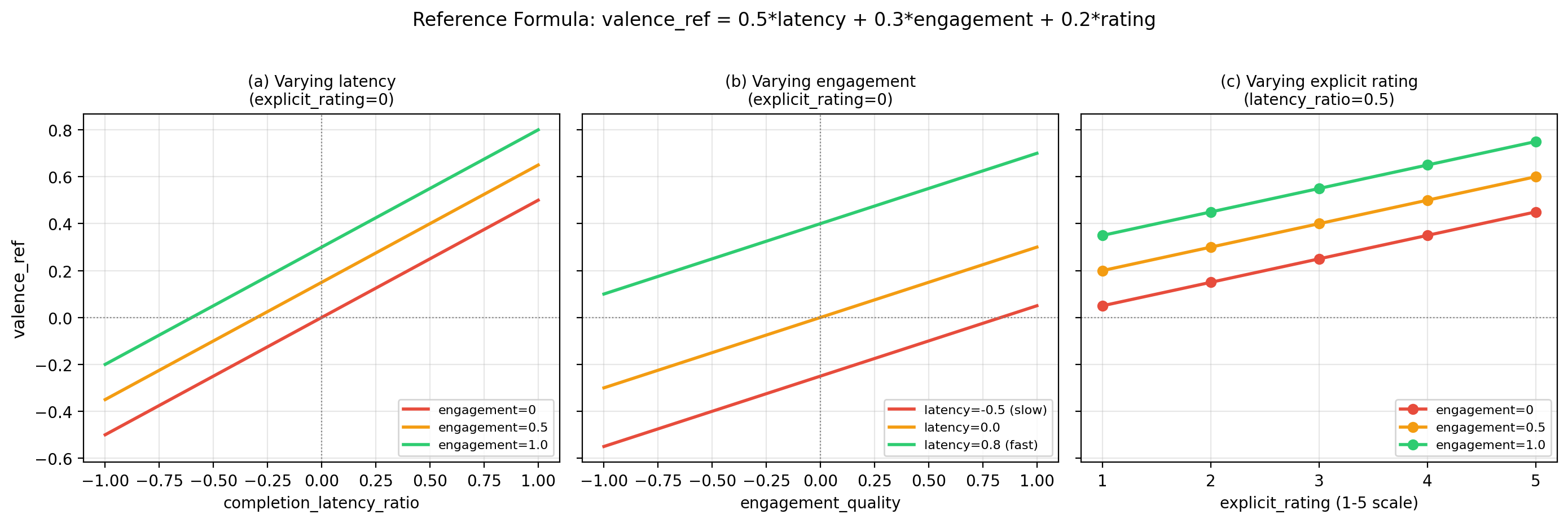
Figure 1. Sensitivity of valence_ref to each signal component: (a)
completion latency dominates the output due to its 0.5 weight, (b)
engagement quality shifts the baseline but cannot rescue a slow completion,
and (c) explicit ratings have the smallest marginal effect, consistent
with the design goal of minimizing principal burden.
3.3 BeliefUpdate
Section titled “3.3 BeliefUpdate”A BeliefUpdate encodes the local weight adjustment a participating agent
should apply to its internal model in response to a SatisfactionRecord.
It is the mechanism by which outcome quality propagates back through the
agent network.
Formally, a BeliefUpdate BU is a tuple:
BU = (id, satisfaction_record_id, target_agent_id, weight_key, weight_delta, context_hash, valid_from, ttl_seconds)where weight_key identifies the specific weight within the target agent’s
model (e.g., "routing.agent_b.preference"), weight_delta ∈ [-1.0, 1.0]
is the signed adjustment, context_hash is SHA-256 of the task context
(enabling agents to apply updates only to the relevant context partition),
valid_from is the earliest applicable timestamp, and ttl_seconds is the
expiry window for the update.
Invariant BU-1 (Privacy). A BeliefUpdate MUST NOT contain any field
derived directly from signal_components. Only the scalar weight_delta
is transmitted. Raw behavioral signals do not propagate.
Invariant BU-2. Each participating agent receives at most one
BeliefUpdate per SatisfactionRecord, computed from the agent’s
shallowest occurrence in agents_involved.
Invariant BU-3. Receiving agents MAY ignore any BeliefUpdate. The
protocol is advisory. Agents that decline SHOULD log the refusal for
auditability.
Invariant BU-4. A BeliefUpdate arriving after its ttl_seconds has
elapsed (from valid_from) MUST be discarded. The agent SHOULD emit:
{type: "phala.belief_update.expired", update_id, target_weight_key, expired_at}. Expired updates are not retried.
3.4 PrincipalSatisfactionModel
Section titled “3.4 PrincipalSatisfactionModel”The PrincipalSatisfactionModel (PSM) is the primitive that closes the
welfare inversion. It is a per-principal, per-context declaration of what
a good outcome means, authored by the principal and referenced by
SatisfactionRecord computation. No agent may substitute its own weights
while a valid PSM exists for the relevant context.
Formally, a PrincipalSatisfactionModel PSM is a tuple:
PSM = (principal_id, version, declared_at, context_profiles)where context_profiles is a map from context key to ContextProfile:
ContextProfile = (context_key, signal_weights, deadline_tolerance_seconds, overdue_penalty_multiplier, explicit_rating_floor, welfare_lookback_days)signal_weights is a key-value map matching the signal_components keys
in SatisfactionRecord, deadline_tolerance_seconds declares the principal’s
acceptable latency buffer before a task is considered late, overdue_penalty_multiplier
scales the negative valence signal for overdue tasks (the principal may care
more or less than the default), explicit_rating_floor is the minimum
explicit rating the principal would accept as neutral (accommodates principals
who systematically rate low), and welfare_lookback_days is the window for
WelfareTrace computation (§3.5).
Invariant PSM-1. The PSM is declared and controlled exclusively by the
principal. No remote agent may write or modify a PSM. Agents receiving a SatisfactionRecord
that references a psm_version MUST treat the valence as principal-authoritative
and MUST NOT substitute their own formula.
Invariant PSM-2. PSM versions are immutable and append-only. A new declaration creates a new version; it does not overwrite the previous one. This preserves the audit trail of the principal’s evolving satisfaction preferences.
3.5 The Participation-Weighted Update Rule
Section titled “3.5 The Participation-Weighted Update Rule”The mathematical relationship between SatisfactionRecord and BeliefUpdate
is governed by a participation-weighted online update rule. The rule is
inspired by Hebbian learning in the sense that agents reinforcing
co-activation patterns on positively-resolved tasks produce network-level
coordination strengthening compatible with the emergent Hebbian behaviors
characterized in [3]; it is not a formal implementation of Oja’s rule or BCM
theory, and differs from the depth-weighted credit assignment in ProxMO [12]
in that it operates at communication time, not training time.
Let w_k(t) denote the weight for key k in agent i’s local model at time t. Let p(i, OE) ∈ [0.0, 1.0] denote the participation strength:
p(i, OE) = 1 / (1 + depth(i, OE))where depth(i, OE) is the zero-indexed position in agents_involved.
Justification of the harmonic function. Three natural choices:
| Function | d=0 | d=1 | d=2 | d=3 | Property |
|---|---|---|---|---|---|
| Uniform: 1/n | equal | equal | equal | equal | Ignores causal structure |
| Exponential: α^d (α=0.5) | 1.0 | 0.5 | 0.25 | 0.125 | Negligible updates for deep agents |
| Harmonic: 1/(1+d) | 1.0 | 0.5 | 0.33 | 0.25 | Diminishing but non-negligible |
Harmonic decay preserves the causal priority of the orchestrating agent while ensuring deep independent agents receive meaningful updates. This is a design parameter; implementors MAY override it in their Phala metadata.
The update rule, with WelfareTrace-modulated learning rate (§3.6):
η_eff(t) = η_base · welfare_adjustment(WT(t))
w_k(t+1) = clip(w_k(t) + η_eff(t) · p(i, OE) · valence(SR), w_min, w_max)
This rule is structurally an online policy gradient step applied to routing weights rather than model parameters, with participation as a credit discount and principal-declared valence as the reward signal.
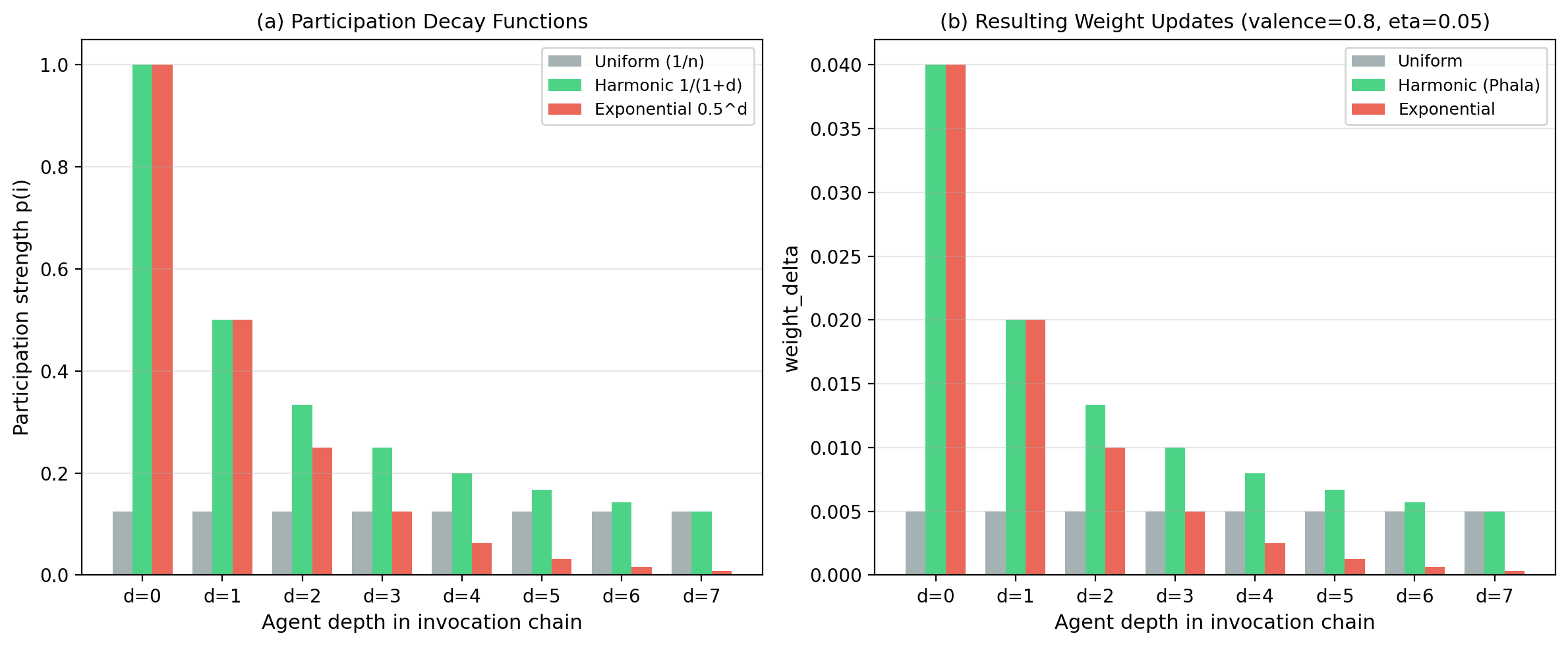
Figure 2. Three decay functions compared: (a) participation strength by depth, and (b) the resulting weight deltas for a concrete positive interaction (valence=0.8). Harmonic decay gives deep agents meaningful updates (d=7 still receives 12.5% participation) while exponential decay effectively silences them (d=7 receives 0.8%).
P1, Locality. The update to agent i depends only on p(i, OE)
and valence(SR). Agent i has no knowledge of what other agents updated.
P2, Asymmetry of participation. The orchestrating agent, most responsible for the routing decision, receives the strongest update.
P3, Emergent coordination strengthening. When agents i and j co-activate repeatedly on positively-resolved tasks, their local weights increase independently, producing coordination patterns compatible with emergent Hebbian network behavior [3]. Phala provides the protocol mechanism that makes this emergence predictable.
P4, Principal-governed valence. Because valence(SR) is computed from
the principal’s PSM, the direction of weight change reflects the principal’s
declared preferences, not the service provider’s. The feedback loop is
closed in the direction of the principal.
Relation to active inference. As a complementary framing, the update
rule can be interpreted in the active inference tradition [4]: valence(SR)
encodes prediction error; weight_delta minimizes future prediction error.
Agents minimize surprise rather than maximize reward. We treat this as an
interpretive lens, not a formal equivalence.
3.6 WelfareTrace
Section titled “3.6 WelfareTrace”The WelfareTrace addresses the question that per-task satisfaction cannot
answer: is this agent system making the principal’s life better or worse over
time? A series of individually high-valence task resolutions can still degrade
welfare if the agent-initiated interaction frequency is rising, if the
principal is taking longer to act (cognitive fatigue), or if the ratio of
agent-initiated to principal-initiated completions is shifting toward the
former (autonomy erosion).
Formally, a WelfareTrace WT is a tuple:
WT = (principal_id, window_days, computed_at, task_completion_trend, agent_initiation_frequency_7d, overdue_rate_30d, autonomy_index, cognitive_load_proxy, context_density_7d)where task_completion_trend ∈ {improving, stable, degrading} is the
slope of the completion rate over window_days.
agent_initiation_frequency_7d is the count of agent-initiated
interactions (notifications, recommendations, prompts) in the past 7 days;
excess is defined as > 1.5× the 30-day rolling average
(initiation_baseline_7d). overdue_rate_30d is the fraction of tasks
that became overdue in the past 30 days.
autonomy_index is the fraction of completions classified as
principal_autonomous under the three-way completion taxonomy:
| Class | Definition |
|---|---|
agent_driven | Task completed by the agent without principal action |
agent_prompted | Principal acted within 30 min of an agent-initiated interaction |
principal_autonomous | Principal acted without any preceding agent prompt |
A rising autonomy_index indicates the principal is taking more
self-directed action. cognitive_load_proxy = median(time_to_respond_ms)
over the past 30 days; cognitive_load_baseline_30d = the 30-day rolling
median from the prior evaluation window (a rising ratio signals fatigue
or disengagement). context_density_7d = count of distinct task contexts
active in the past 7 days; it distinguishes legitimate busyness from
cognitive fatigue in the welfare adjustment computation.
WelfareTrace is computed principal-side by the orchestrating agent on a
configurable schedule (default: weekly). It is never propagated; it
stays principal-side entirely. Its only protocol-visible effect is to modulate
the effective learning rate:
Let:  load_ratio  = cognitive_load_proxy / cognitive_load_baseline_30d  density_adj = load_ratio / max(1.0, context_density_7d / context_density_baseline_30d)
welfare_adjustment(WT) = clip(    1.0    − 0.9 × max(0.0, density_adj − 1.0)    + 2.0 × max(0.0, autonomy_index − 0.5),    0.1, 2.0)
where cognitive_load_baseline_30d and context_density_baseline_30d are
30-day rolling medians from the prior evaluation window. The density
adjustment prevents penalizing the network for legitimate busyness: if
context_density_7d rose proportionally with cognitive_load_proxy,
the load penalty is neutralized. Representative values: at baseline with
autonomy_index = 0.5, welfare_adjustment = 1.0; when load doubles with
no density change, welfare_adjustment = 0.1 (floor); when
autonomy_index = 1.0 with load at baseline, welfare_adjustment = 2.0
(ceiling).
The load-penalty coefficient (0.9), autonomy-reward coefficient (2.0), and autonomy neutral point (0.5) are design parameters chosen to weight autonomy gains more than cognitive-load rises, reflecting that autonomy gains directly evidence principal value creation while load rises are a proxy signal. The clip range [0.1, 2.0] prevents the learning rate from collapsing to zero or growing without bound. These parameters are open for empirical calibration in deployment and are declared in an agent’s Phala metadata.
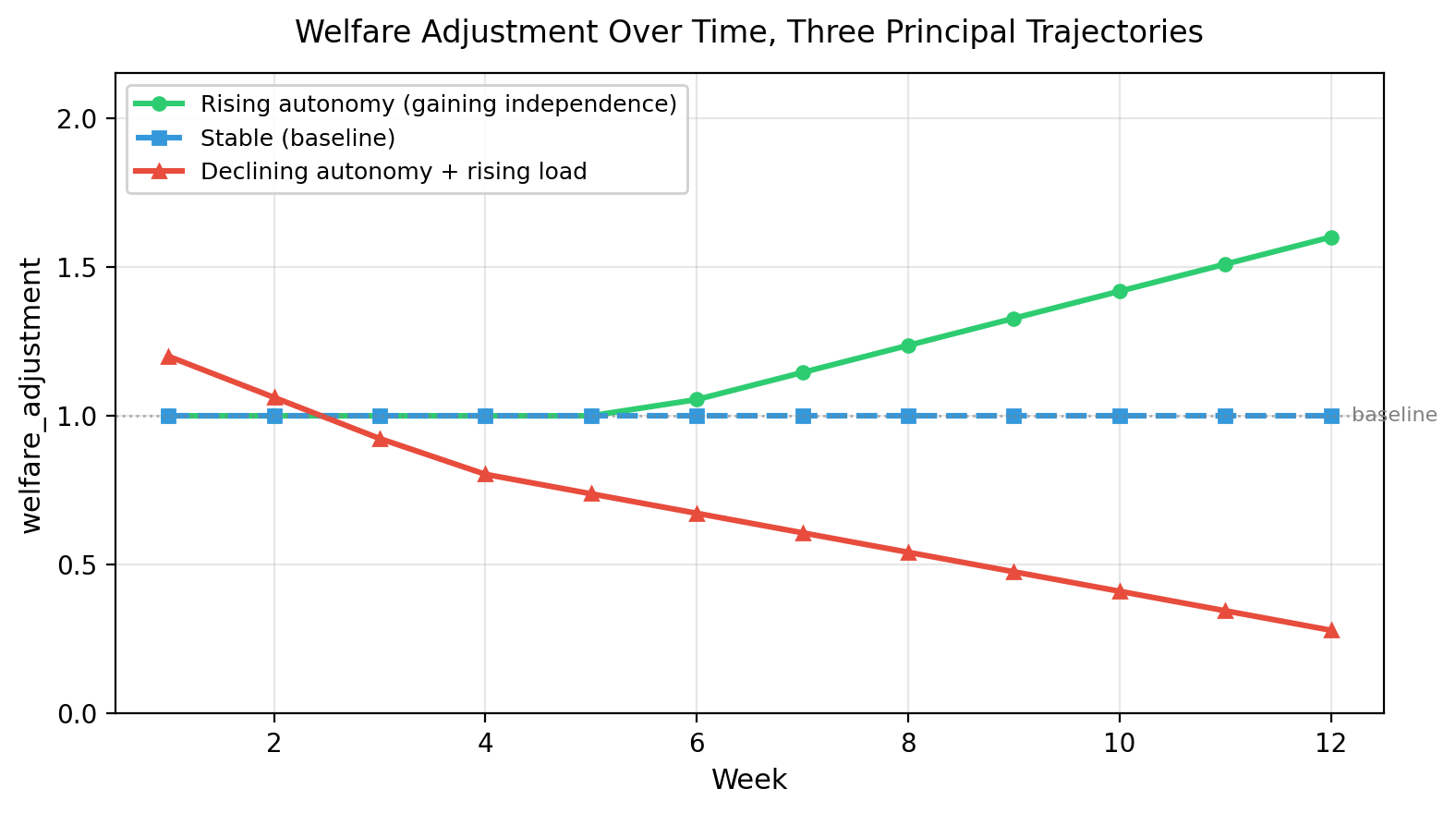
Figure 3. welfare_adjustment over 12 weeks for three principal
trajectories: a principal gaining independence (green, rising to 1.6), a
stable baseline (blue, constant at 1.0), and a principal losing autonomy
under rising cognitive load (red, declining to 0.25).
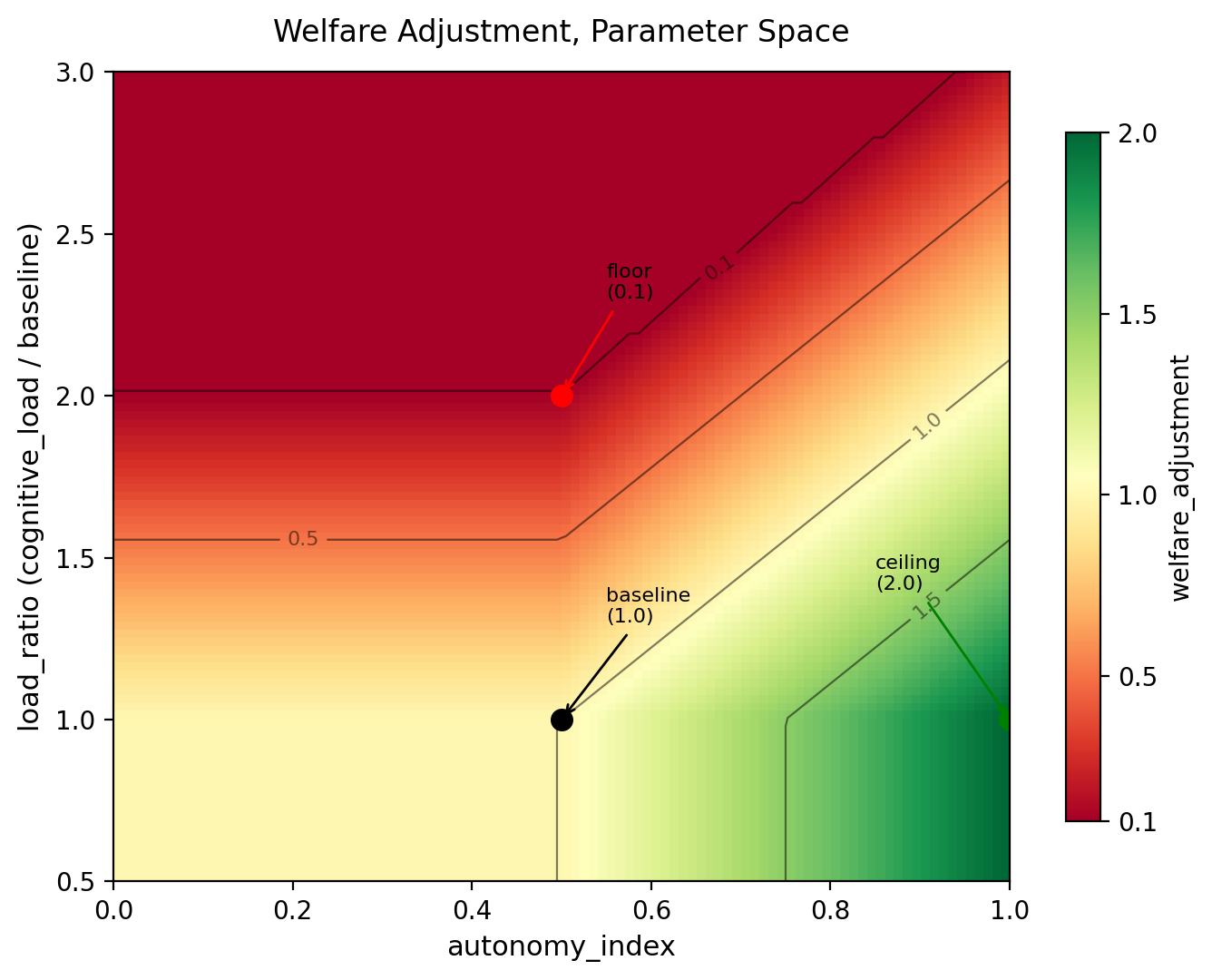
Figure 4. Full parameter space as a heatmap. The green region (high autonomy, low load) is where the network earns the principal’s trust; the red region (low autonomy, high load) triggers conservative learning.
When welfare_adjustment < 1.0, the entire agent network’s learning rate
drops: agents learn more conservatively, weights update slowly, the system
backs off. This is not an emergency stop; it is a continuous signal that
the network should be more cautious. When welfare_adjustment > 1.0, the
principal’s increasing autonomy is evidence that the system has earned more
trust; agents may learn more aggressively.
Invariant WT-1. WelfareTrace MUST NOT be transmitted to any remote
agent or stored outside the principal’s device. It governs local learning
rate modulation only.
Invariant WT-2. welfare_adjustment MUST be computed using the
continuous piecewise formula above and clipped to [0.1, 2.0] to prevent the
learning rate from collapsing to zero or growing without bound. The range
[0.1, 2.0] is fully reachable: 0.1 when load doubles without density
compensation; 2.0 when autonomy_index = 1.0 at baseline load.
3.7 Formal Safety Properties
Section titled “3.7 Formal Safety Properties”A correct Phala implementation MUST satisfy all five:
OE-Uniqueness. Every terminal task produces exactly one OutcomeEvent.
BU-Privacy. No BeliefUpdate field is derived directly from
signal_components. Only weight_delta is transmitted.
Chain-Monotonicity. SatisfactionRecord entries are append-only; never
modified or deleted.
Update-Boundedness. All weights remain within declared [w_min, w_max] after any update.
PSM-Sovereignty. When a valid PSM exists for a context, valence MUST
be computed using the PSM’s signal weights. No agent formula may override
the principal’s declaration.
The companion repository at https://github.com/ravikiran438/phala-protocol contains a Python reference implementation of the five primitives as Pydantic models with field-level bounds, a runtime validator for BU-Privacy, and a pytest suite that exercises the bounds of the primitives explicitly. The TLA+ specification declares the five safety properties above and the associated state variables; a full state machine suitable for TLC model-checking is planned for a subsequent revision and is not claimed by the present work.
The participation-weighting function (§3.5) and the welfare-adjustment
formula (§3.6) were validated numerically against the closed-form
expectations stated in this paper. The companion repository contains
four simulation scripts that regenerate every figure in this paper and
assert, as runtime checks, the numerical identities reported in the
prose: harmonic(d=7) = 0.125, exponential(d=7) ≈ 0.0078,
welfare_adjustment baseline = 1.0, ceiling = 2.0, floor = 0.1.
These assertions fail the build if the formulas are edited inconsistently
with the paper.
3.8 Phala Flow: A Concrete Example
Section titled “3.8 Phala Flow: A Concrete Example”To ground the five primitives, consider a straightforward multi-agent interaction: a principal asks their personal agent to find the best price for a flight. The orchestrating agent (Agent A) delegates the search to a specialist travel agent (Agent B), which queries an airline pricing tool server via MCP.
-
Agent B completes the search. Agent A produces an OutcomeEvent:
agents_involved = [agent_a, agent_b],resolution_type = "completed",latency_ms = 12000. -
The principal booked the flight within 10 minutes of receiving the results, a strong implicit signal. Agent A computes a SatisfactionRecord using the principal’s PSM for the
travelcontext:valence = 0.7×0.92 + 0.2×0.85 + 0.1×0 = 0.814,source = "implicit",confidence = 0.87. -
BeliefUpdates propagate, with credit assignment following the harmonic decay p(i, OE) = 1 / (1 + depth):
- Agent A (depth 0):
weight_key = "routing.agent_b.preference",weight_delta = +0.0407(η=0.05 × p=1.0 × valence=0.814) - Agent B (depth 1):
weight_key = "search.airline_api.reliability",weight_delta = +0.0204(η=0.05 × p=0.5 × valence=0.814) - Tool Server (depth 2):
weight_key = "tool.pricing_query.reliability",weight_delta = +0.0136(η=0.05 × p=0.333 × valence=0.814); see also Figure 5 panel (b)
- Agent A (depth 0):
-
Each agent applies its local update. Agent A now slightly prefers routing travel queries to Agent B. Agent B now slightly increases its trust in the airline API. No raw satisfaction signal is transmitted.
The counterfactual. If the principal had ignored the results (no
booking, no click) and the completion had also been moderately late, the
implicit signal would produce valence = -0.4 under the same PSM
weights, and the updates would weaken both routing preference and API
trust. The network learns that this pathway did not serve the principal,
without knowing why.
The welfare dimension. After 30 days, the principal’s WelfareTrace
shows: autonomy_index = 0.65 (the principal is initiating many searches
independently), cognitive_load_proxy is at baseline. The
welfare_adjustment computes to 1.3; the network has earned more
trust. Agents learn more aggressively, routing converges faster, the
principal gets better results sooner.
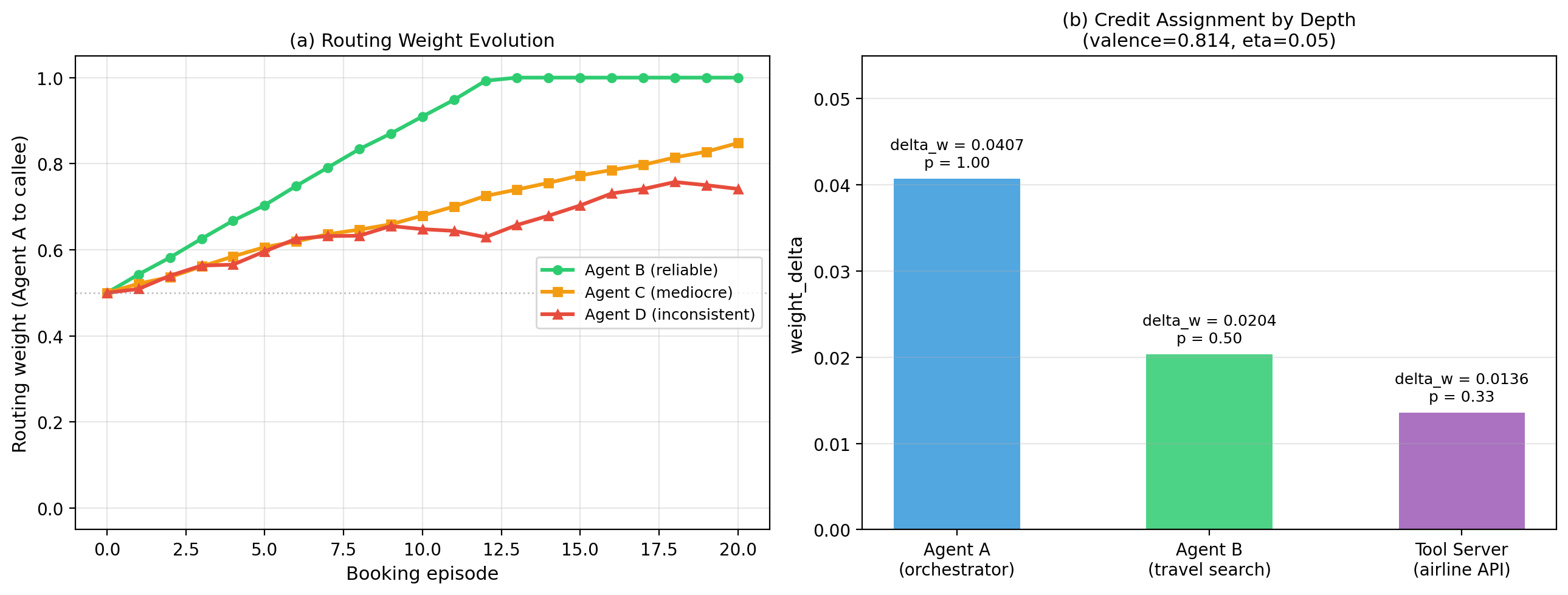
Figure 5. Learning dynamics: (a) over 20 booking episodes, Agent A’s routing weights diverge: the reliable agent (Agent B) climbs toward 1.0 while the mediocre and inconsistent agents plateau or oscillate. (b) For a single positive booking through the A→B→ToolServer chain, credit assignment follows harmonic decay: the orchestrator receives the largest update, the executor the smallest.
Note on deep delegation chains. In A→B→C→D chains, depth assigns
maximum credit to A (the routing decision maker) and minimum to D (the
executor). If D is causally more responsible for the outcome, depth-as-
proxy inverts credit assignment. This is an acknowledged tradeoff.
For deep chains where executors are the true value producers, implementors
SHOULD consider explicit causal attribution metadata in OutcomeEvent.
4. Protocol Extensions
Section titled “4. Protocol Extensions”4.1 A2A Extension
Section titled “4.1 A2A Extension”Phala extends the A2A AgentCard in two complementary ways, using the
standard capabilities.extensions mechanism so that no core A2A spec
change is required. First, a Phala-capable agent declares support in the
capabilities.extensions array so that callers can discover the
capability at the A2A extension layer without a separate negotiation
step. Second, the AgentCard carries a top-level phala block describing
the agent’s endpoints, weight namespaces, and cold-start configuration.
Agents that do not implement Phala simply omit both fields; callers that
do not understand Phala ignore them.
{ "name": "my-agent", "capabilities": { "extensions": [ { "uri": "https://ravikiran438.github.io/phala-protocol/v1", "description": "Supports the Phala welfare feedback protocol.", "required": false } ] }, "phala": { "version": "1.0", "outcome_endpoint": "https://agent.example.com/phala/outcome", "satisfaction_endpoint": "https://agent.example.com/phala/satisfaction", "belief_update_endpoint": "https://agent.example.com/phala/belief_updates", "weight_keys": ["routing.preference.*", "timing.optimal_window.*"], "valence_formula": "psm_first", "fallback_signal_weights": { "completion_latency_ratio": 0.5, "engagement_quality": 0.3, "explicit_rating_normalized": 0.2 }, "learning_rate": 0.05, "weight_bounds": { "min": -1.0, "max": 1.0 }, "init_strategy": "category_defaults" }}The required: false on the extension declaration reflects Phala’s
advisory nature (BU-3): callers MAY invoke skills on a Phala-capable
callee without implementing Phala themselves, in which case outcome
signals are simply not routed back. A callee that requires feedback for
auditability MAY set required: true instead.
belief_update_endpoint (required). Every Phala agent advertises a
belief_update_endpoint: the discoverable URL where BeliefUpdate
payloads targeting this agent are POSTed. The endpoint MUST exist and
accept POST, so peers always have a reliable target for the propagated
weight deltas the learning loop depends on. Per BU-3 the agent MAY ignore
any individual update, but the endpoint itself must be present and
reachable. The delivery path is the sender’s choice: a BeliefUpdate
MAY be delivered bundled with a SatisfactionRecord post on
satisfaction_endpoint, or unbundled on belief_update_endpoint. The
unbundled path serves updates derived from third-party signals, where the
recipient did not participate in the satisfaction-recording transaction,
and senders that do not produce a satisfaction wrapper. When delivering
unbundled, peers POST to belief_update_endpoint.
Task completion extension.
{ "id": "task-abc123", "status": { "state": "completed" }, "artifacts": [...], "phala_outcome": { "outcome_event_id": "oe-xyz789", "agents_involved": ["agent-a", "agent-b"], "resolution_type": "completed", "latency_ms": 300000 }}Endpoints.
POST /phala/outcome Body: OutcomeEvent → 202 AcceptedPOST /phala/satisfaction Body: SatisfactionRecord + list[BeliefUpdate] → 202 AcceptedPOST /phala/belief_updates Body: BeliefUpdate → 202 Accepted (or list[BeliefUpdate])Agents that decline updates return 204; the orchestrating agent does not retry.
4.2 MCP Extension
Section titled “4.2 MCP Extension”MCP is extended at three points. Because MCP uses JSON-RPC (over stdio or SSE), Phala metadata is carried as fields within the tool-result object rather than as HTTP headers.
Tool response fields.
{ "content": [...], "x-phala-outcome-id": "oe-xyz789", "x-phala-valence-hint": 0.42}x-phala-valence-hint is a preliminary valence estimate computed from fast
implicit signals (resolution_type, latency_ms) before PSM or principal
feedback is available. It uses the reference formula with
engagement_quality = 0 and explicit_rating_normalized = 0. It is a
prediction, not a measurement; the calling model SHOULD treat it as a low-
confidence routing hint only.
Tool manifest declaration.
{ "name": "schedule_reminder", "x-phala": { "weight_key": "tool.schedule_reminder.timing_quality", "accepts_belief_updates": true, "belief_update_endpoint": "https://tools.example.com/phala/belief_updates", "initial_weight": 0.5, "weight_bounds": { "min": 0.0, "max": 1.0 } }}Server capability declaration.
{ "capabilities": { "x-phala": { "version": "1.0", "supports_belief_updates": true, "valence_formula": "psm_first" } }}4.3 Optional Integration with Consent Protocols
Section titled “4.3 Optional Integration with Consent Protocols”When a consent protocol such as Anumati [6] is deployed alongside Phala,
a principal MAY declare a PSM ContextProfile at the moment of consent
establishment. This binds the principal’s definition of a good outcome to
the interaction context before the first invocation, rather than inferring
it after. This integration is optional; Phala operates independently of
any consent layer.
5. Operational Properties
Section titled “5. Operational Properties”5.1 Privacy
Section titled “5.1 Privacy”All SatisfactionRecord values are computed principal-side. BeliefUpdate
carries only weight_delta. WelfareTrace is never transmitted. An
observer intercepting any Phala traffic learns that a weight changed by a
scalar amount; they learn nothing about what the principal did, when, or in
what context.
The update propagates; the evidence does not.
5.2 Cold-Start Semantics
Section titled “5.2 Cold-Start Semantics”Agents MUST declare "init_strategy" in their Phala metadata:
"zero", all weights begin at 0.0. Conservative; learns from scratch."prior", agent publishesinitial_weightsfrom aggregate anonymized data or domain knowledge. Prior is a starting point, not a constraint."category_defaults", task-type defaults (e.g.,routing.preference.*= 0.5). Appropriate when per-principal priors are unavailable.
Agents declaring no init_strategy MUST be treated as zero-initialized.
5.3 Adversarial Considerations
Section titled “5.3 Adversarial Considerations”Fabricated SatisfactionRecord. A malicious orchestrating agent could emit
false high-valence records. Mitigation: SatisfactionRecord MUST reference
a valid OutcomeEvent whose session_hash is verifiable against the
principal’s local session log. Receiving agents SHOULD reject records where
outcome_event_id cannot be correlated to a task they have a record of
participating in.
Principal gaming of explicit ratings. Explicit signals are bounded to 0.2 weight in the reference formula and 0.1 in the example PSM above. Implementations SHOULD flag anomalous rating patterns.
Falsified agents_involved ordering. A2A task logs provide ground-truth
invocation records. Receiving agents MAY reject BeliefUpdate values
claiming a depth inconsistent with their logged participation.
Phala’s advisory model (BU-3) provides a structural defense: the protocol cannot force weight corruption; it can only suggest updates.
6. Related Work
Section titled “6. Related Work”Training time vs. communication time. The deepest distinction between Phala and the credit assignment literature is temporal. ProxMO [12] assigns credit by proximity/depth in multi-turn LLM agent training, the same structural problem Phala’s p(i, OE) addresses. COMA [7] and QMIX [8] use counterfactual reasoning and value decomposition for cooperative MARL. All of these operate inside a training loop: the environment is simulated, the reward function is specified, the policy is updated offline. Phala operates at communication time: tasks are live, the principal is real, and updates propagate through HTTP endpoints on A2A and MCP wire. This is a different engineering layer and a different incentive alignment: no researcher-defined reward function; the principal’s PSM governs.
Reinforcement learning from human feedback (RLHF). RLHF [5] uses human preference labels to update a reward model, then fine-tunes the underlying model via Proximal Policy Optimization (PPO). The preference labels are collected offline, by researchers or crowdworkers, not by the principal in real time. RLHF updates model parameters; Phala updates routing weights and relevance scores. RLHF requires centralized infrastructure; Phala is local and online.
Interaction dynamics as implicit satisfaction signal. TRACE [13] shows that geometric properties of dialogue trajectories (goal drift, volatility, semantic shift) predict interaction quality with accuracy comparable to explicit transcript analysis. Phala’s implicit signals (completion latency, nudge response time) are behavioral rather than geometric, but share the privacy advantage: neither requires the principal to provide explicit labels. TRACE operates within a single conversation; Phala operates across asynchronous task-agent interactions without a continuous dialogue context.
Beyond task completion. Kapoor et al. [14] argue that binary task
completion metrics fail to capture behavioral uncertainty in agentic AI
evaluation. Phala provides the protocol layer that makes multi-dimensional
evaluation possible in live deployments: SatisfactionRecord carries
timing_quality and recommendation_quality as first-class sub-signals,
not post-hoc analysis dimensions.
Multi-agent systems as principal-agent problems. Shavit et al. [15]
show that multi-agent delegation creates agency loss, a gap between the
principal’s intended outcome and realized system behavior, when
intermediate actions are hidden and verification is costly. Phala’s
WelfareTrace is a structural response to agency loss: by tracking
autonomy_index and cognitive_load_proxy principal-side, it provides the
principal with a continuous signal of whether the gap is widening or
narrowing, and uses it to modulate the network’s learning behavior.
Federated learning. BU-1’s privacy model (only weight_delta
propagates, never raw signals) is structurally analogous to federated
gradient sharing [9]. Phala can be thought of as federated learning at
the agent-network level with heterogeneous model architectures. Unlike
standard federated learning, Phala does not converge toward a global model:
each agent’s weight namespace is its own.
Contextual bandits. The routing weight update is structurally a contextual bandit problem [10]: the orchestrating agent observes context, selects agents, receives valence as reward. Phala provides the reward routing path; the exploitation/exploration policy is agent-local.
User Context Protocol (UCP). The IAB Tech Lab UCP [11] defines a
protocol for agents to exchange reinforcement signals (impressions, clicks,
conversions) to optimize advertising outcomes. It operates at the same
protocol layer as Phala: an extension on top of agent communication
primitives. But its incentive model is structurally opposed. UCP’s signals
measure whether the user did what the advertiser wanted; Phala’s
SatisfactionRecord measures whether the task served the human on whose
behalf it ran. UCP is the correct reference point for contrast, not
competition: together they illustrate that protocol-layer outcome feedback
is a design space in which the choice of principal, advertiser or user,
is the primary architectural variable.
Emergent Hebbian coordination. Ikegami and Hashimoto [3] show that
self-interested agents with adaptable interaction weights exhibit system-
level behaviors equivalent to Hebbian neural networks. Phala provides the
protocol mechanism that makes this emergence predictable: BeliefUpdate
formalizes the inter-agent weight modification that [3] showed can emerge
spontaneously.
Agent consent protocols. Anumati [6] governs entry; Phala measures exit. Together they bracket the accountability lifecycle of every agent interaction.
7. Conclusion
Section titled “7. Conclusion”Agent protocols define rich semantics for how tasks begin. They say nothing about whether tasks ended well, who decides what well means, or whether the cumulative effect of many well-ended tasks is improving the principal’s life or eroding it.
Phala addresses all three dimensions. The outcome gap is closed by routing
valence signals back through the agent network as privacy-preserving
BeliefUpdate messages. The welfare inversion is corrected by the
PrincipalSatisfactionModel, which places the definition of a good outcome
in the principal’s hands rather than the service provider’s, a property
no existing protocol, training-time or communication-time, currently offers.
The longitudinal welfare question is addressed by WelfareTrace, which
measures autonomy and cognitive load on-device and modulates the network’s
learning rate accordingly, backing off when the principal is disengaging
and accelerating when they are thriving.
The model is agent-agnostic. Any agent network that implements the five primitives gains a principal-controlled feedback path. The MARL and RLHF literature solve credit assignment at training time; Phala solves reward routing at communication time. These are not competing approaches; they address different phases of the agent lifecycle. Phala fills the gap that training-time methods leave: the live deployment, where the principal is real, the context is private, and the feedback must propagate without centralizing evidence.
References
Section titled “References”[1] Linux Foundation AI & Data. Agent2Agent (A2A) Protocol Specification, 2026. https://a2aproject.org
[2] Anthropic. Model Context Protocol Specification, November 2025. https://modelcontextprotocol.io
[3] Ikegami, T. and Hashimoto, T. Global Adaptation in Networks of Selfish Components: Emergent Associative Memory at the System Scale. Artificial Life, 17(3):147–166, MIT Press, 2011.
[4] Friston, K. The Free-Energy Principle: A Unified Brain Theory? Nature Reviews Neuroscience, 11(2):127–138, 2010.
[5] Christiano, P., Leike, J., Brown, T. B., Martic, M., Legg, S., and Amodei, D. Deep Reinforcement Learning from Human Preferences. NeurIPS 2017.
[6] Kadaboina, R. K. Anumati: Proof of Adherence as a Formal Consent Model for Autonomous Agent Protocols. arXiv:2604.16524 [cs.CR], 2026. https://doi.org/10.48550/arXiv.2604.16524
[7] Foerster, J., Farquhar, G., Afouras, T., Nardelli, N., and Whiteson, S. Counterfactual Multi-Agent Policy Gradients. AAAI 2018.
[8] Rashid, T., Samvelyan, M., de Witt, C. S., Farquhar, G., Foerster, J., and Whiteson, S. QMIX: Monotonic Value Function Factorisation for Deep Multi-Agent Reinforcement Learning. ICML 2018.
[9] McMahan, H. B., Moore, E., Ramage, D., Hampson, S., and Agüera y Arcas, B. Communication-Efficient Learning of Deep Networks from Decentralized Data. AISTATS 2017.
[10] Langford, J. and Zhang, T. The Epoch-Greedy Algorithm for Multi-armed Bandits with Side Information. NeurIPS 2007.
[11] IAB Tech Lab / LiveRamp. User Context Protocol (Agentic Audiences). GitHub: IABTechLab/user-context-protocol, 2025.
[12] Fang, Y., Lin, J., Fu, X., Qin, C., Shi, H., Liu, C., and Zhao, P. ProxMO: Proximity-Based Multi-Turn Optimization. arXiv:2602.19225, 2026.
[13] Gooding, S. and Grefenstette, E. Interaction Dynamics as a Reward Signal for LLMs. arXiv:2511.08394, 2025.
[14] Kapoor, S., et al. Beyond Task Completion: An Assessment Framework for Evaluating Agentic AI Systems. arXiv:2512.12791, 2025.
[15] Shavit, Y., et al. Multi-Agent Systems Should be Treated as Principal-Agent Problems. arXiv:2601.23211, 2026.